 Mad Over Stories Team
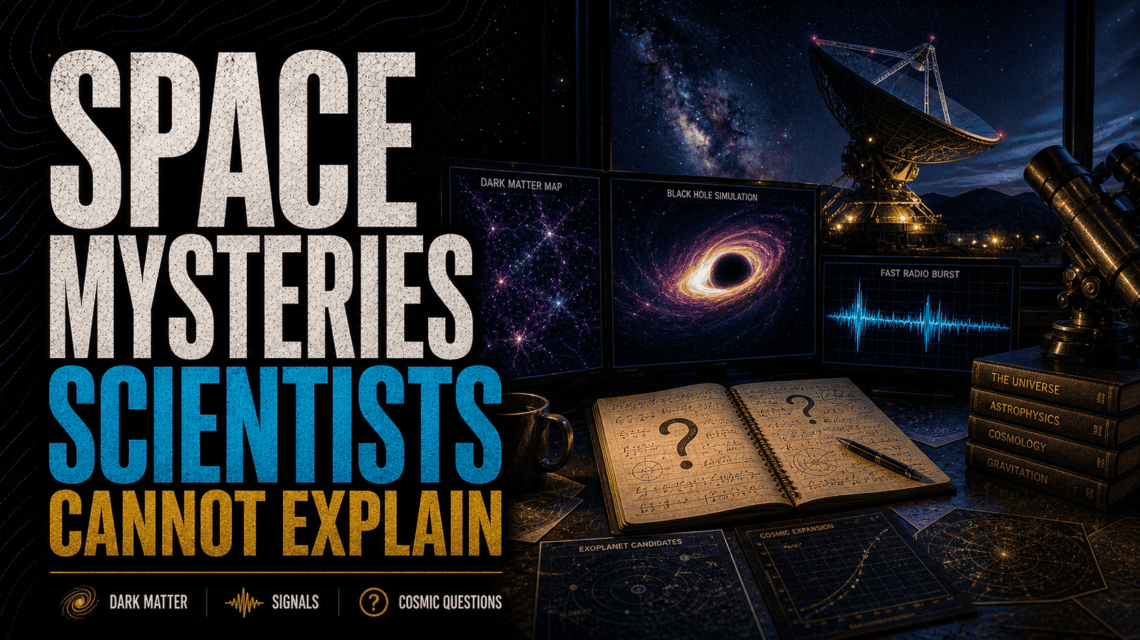
 For all that modern astronomy has mapped, some of the biggest questions about the universe remain genuinely open. It is worth separating what we actually know from what we do not, so below, each item makes clear where solid measurement ends and real mystery begins.
Some links below are affiliate links. As an Amazon Associate, Mad Over Stories earns from qualifying purchases.
The universe’s missing ingredients
Dark matter
Galaxies rotate faster than the visible matter in them should allow, and galaxy clusters bend light more strongly than their stars can explain. The known fix is that roughly a quarter of the universe is some form of matter that does not emit or absorb light. That much is well established from many independent observations. What dark matter actually is, however, remains unknown; decades of sensitive experiments have not yet caught a particle of it.
Dark energy
In 1998, two teams measuring distant supernovae found that the expansion of the universe is not slowing down but speeding up. To account for this acceleration, cosmologists invoke “dark energy,” which appears to make up about 68 percent of the universe. It is one of the most solidly measured facts in cosmology and, at the same time, one of the least understood; we do not know what it is or why it has the value it does.
The Hubble tension
Two respected ways of measuring how fast the universe is expanding, one from the early-universe cosmic microwave background and one from nearby stars and supernovae, give answers that stubbornly disagree by several percent. As measurements have grown more precise, the gap has not closed. This “Hubble tension” is a live puzzle that could hint at something missing in our standard model of cosmology.
Objects and silences we cannot explain
Fast radio bursts
These are millisecond flashes of radio energy arriving from far across the universe, and their exact origins are still being worked out. Because they are a topic in their own right, we cover them separately in Mysterious Radio Signals From Space.
‘Oumuamua, our first interstellar visitor
In 2017, astronomers detected the first confirmed object from beyond our solar system passing through it, named ‘Oumuamua. It was oddly elongated, tumbling, and showed a slight acceleration not fully explained by gravity alone. Most researchers favor natural explanations such as venting gases, but because it left before we could study it closely, some details remain unresolved.
The Fermi paradox
The galaxy is old and vast, so if technological life is common, we might expect some sign of it, yet we see none. That contradiction, named after physicist Enrico Fermi, is not a mystery about a specific object but about our place in the cosmos. Proposed answers range from life being rare, to civilizations being short-lived, to our simply not having looked well enough or long enough.
If cosmology’s open questions fascinate you, astrophysicist Katie Mack explores several of them with clarity and wit in the book below.

The End of Everything Astrophysically Speaking
Astrophysicist Katie Mack's clear, witty guide to dark energy, cosmic fate, and the universe's biggest open questions.
View on Amazon →Related Reading
Research Notes
- Pew Research Center
- Edison Research True Crime Consumer Report
- Google Trends Summergeist
- AP / Publishers Weekly best-seller list
Editorial note: Mad Over Stories prioritizes source-aware storytelling. For true crime and real-life topics, we avoid naming private individuals unnecessarily, distinguish confirmed facts from interpretation, and update articles when better information becomes available.
More From Mad Over Stories
You Might Also Like

Ancient Technology Discoveries That Make the Past Feel More Inventive
Mysterious Radio Signals From Space: What Fast Bursts May Be Telling Us

Best Science Books for Curious Adults Who Want Wonder Without Jargon

Scientific Discoveries Everyone Should Know Because They Changed Daily Life

Deep Ocean Mysteries: Why Earth's Largest Habitat Still Feels Alien