 Mad Over Stories Team
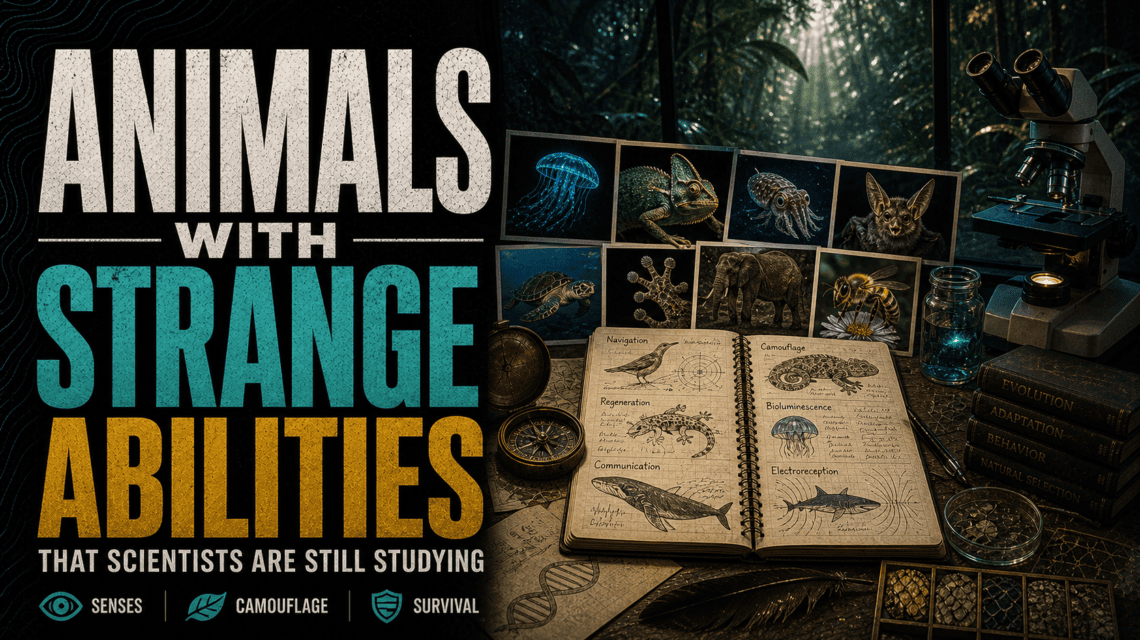
 Biology is full of animals whose everyday abilities still push the limits of what researchers understand. These are not myths or exaggerations; they are living organisms doing things we are still working to fully explain. Here are five whose talents keep scientists busy.
Some links below are affiliate links. As an Amazon Associate, Mad Over Stories earns from qualifying purchases.
Survivors and shape-shifters
Tardigrades and cryptobiosis
Tardigrades, or “water bears,” are microscopic animals that can survive being dried out, frozen near absolute zero, boiled, and even exposed to the vacuum and radiation of open space. They do it by entering cryptobiosis, curling into a dehydrated “tun” state in which metabolism nearly stops. Part of their trick involves special proteins that turn their cells’ interiors into a protective, glass-like solid, a mechanism researchers are still probing for uses in preserving vaccines and cells.
Axolotls and regeneration
The axolotl, a salamander from Mexico, can regrow entire limbs, parts of its heart, and even portions of its brain and spinal cord, without scarring. Where a human forms scar tissue, the axolotl forms a blastema, a mass of cells that rebuilds the missing structure correctly. Understanding how it reactivates these developmental programs is a major goal of regenerative medicine.
The “immortal” jellyfish
The tiny jellyfish Turritopsis dohrnii can respond to stress or injury by reverting its adult cells to an earlier stage and settling back into a juvenile polyp, effectively starting its life cycle over. This transdifferentiation means it can, in principle, escape death by old age, which is why it is nicknamed the immortal jellyfish. Individuals still get eaten or sick, but the reset trick is genuinely remarkable.
Extreme senses and weapons
The mantis shrimp’s eyes and strike
Mantis shrimp have some of the most complex eyes known, with up to a dozen or more types of photoreceptor (compared with our three) and the ability to detect polarized light. Their raptorial claws strike so fast they briefly boil the surrounding water into collapsing cavitation bubbles, delivering a second shockwave that can crack shells and aquarium glass. How their brains process such rich visual data is still being studied.
Electroreception in sharks and the platypus
Sharks and rays sense the faint electric fields given off by living muscle through jelly-filled pores called the ampullae of Lorenzini, letting them find prey hidden in sand or murky water. The platypus, a mammal, independently evolved electroreceptors in its bill and hunts with its eyes, ears, and nostrils shut, relying on electric and touch signals underwater. This shared sense in such different animals is a striking case of convergent evolution.
For a vivid tour of animal senses that reads like a page-turner, the book below is a rare treat.

An Immense World
A Pulitzer-winning tour of how animals sense the world, from electric fields to polarized light.
View on Amazon →Related Reading
- Science Discovery
- Strange Medical Cases Explained: When the Body Becomes the Mystery
- Best Science Books for Curious Adults Who Want Wonder Without Jargon
Research Notes
- Pew Research Center
- Edison Research True Crime Consumer Report
- Google Trends Summergeist
- AP / Publishers Weekly best-seller list
Editorial note: Mad Over Stories prioritizes source-aware storytelling. For true crime and real-life topics, we avoid naming private individuals unnecessarily, distinguish confirmed facts from interpretation, and update articles when better information becomes available.
More From Mad Over Stories
You Might Also Like

Ancient Technology Discoveries That Make the Past Feel More Inventive

Mysterious Radio Signals From Space: What Fast Bursts May Be Telling Us

Best Science Books for Curious Adults Who Want Wonder Without Jargon

Scientific Discoveries Everyone Should Know Because They Changed Daily Life
Deep Ocean Mysteries: Why Earth's Largest Habitat Still Feels Alien