 Mad Over Stories Team
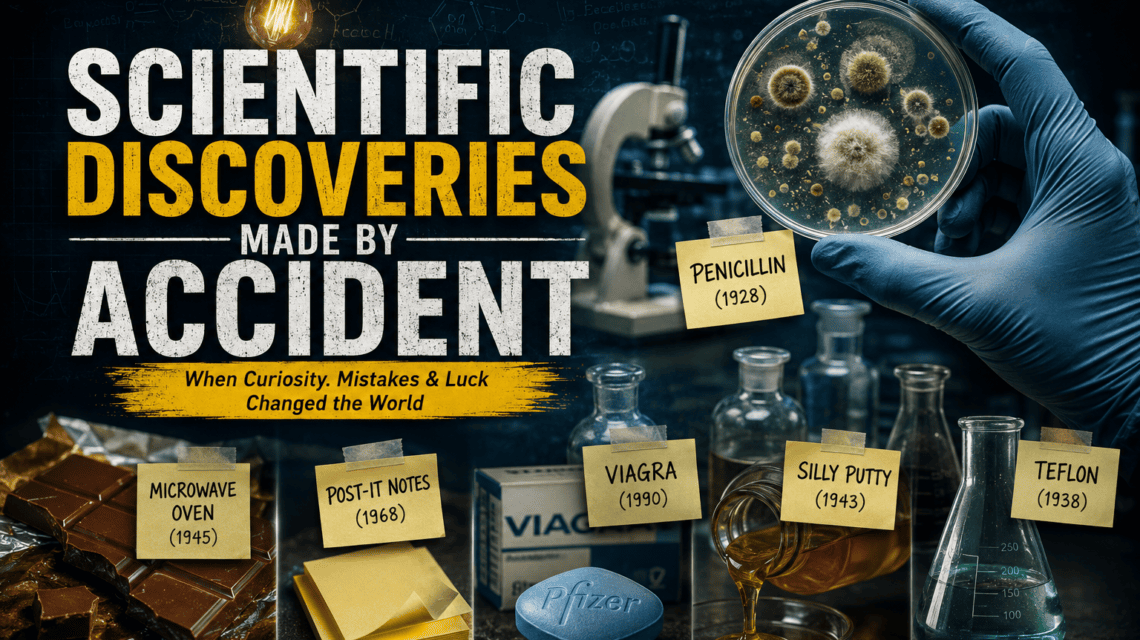
 Some of the most important discoveries in scientific history weren’t the result of careful planning — they were accidents noticed by people prepared to understand them. Here are twelve times a mistake, a mess, or a malfunction changed the world.
1. Penicillin (1928)
Alexander Fleming returned from vacation to find a mold contaminating his staphylococcus cultures — and a clear ring around it where bacteria wouldn’t grow. That stray Penicillium spore became the first true antibiotic, eventually saving hundreds of millions of lives. Fleming’s own verdict: “One sometimes finds what one is not looking for.”
2. X-rays (1895)
Wilhelm Röntgen was experimenting with cathode ray tubes when a fluorescent screen across the room began to glow — through cardboard shielding. Within weeks he had produced the famous image of his wife’s hand, bones and wedding ring visible. She reportedly said, “I have seen my death.” He received the first Nobel Prize in Physics for it.
3. The microwave oven (1945)
Raytheon engineer Percy Spencer was standing near an active radar magnetron when the chocolate bar in his pocket melted. He tested popcorn kernels next (they popped), then an egg (it exploded). The first commercial “Radarange” followed in 1947 — it weighed about 340 kg.
4. Vulcanized rubber (1839)
Charles Goodyear had spent years trying to make rubber stop melting in summer and cracking in winter. The breakthrough came when a sulfur-treated sample accidentally touched a hot stove — and instead of melting, it charred into a stable, springy material. Every tire on the road descends from that accident.
5. Safety glass (1903)
Édouard Bénédictus knocked a glass flask off a shelf and noticed it cracked but held together — it had contained a cellulose nitrate solution that left an invisible film inside. Laminated safety glass now sits in every car windshield in the world.
6. Saccharin (1879)
Chemist Constantin Fahlberg forgot to wash his hands after a day working with coal tar derivatives and noticed his dinner roll tasted oddly sweet. He had discovered the first artificial sweetener — roughly 300 times sweeter than sugar.
7. Teflon (1938)
DuPont chemist Roy Plunkett opened a cylinder of tetrafluoroethylene gas and found it had spontaneously polymerized into a waxy, astonishingly slippery solid that resisted heat, acids, and almost everything else. From nonstick pans to spacecraft, PTFE became one of the most useful materials ever made by mistake.
8. Radioactivity (1896)
Henri Becquerel planned to study how uranium salts fluoresced in sunlight — but Paris stayed overcast, so he shut the wrapped photographic plates and uranium in a drawer. When he developed the plates anyway, they were fogged: the uranium emitted radiation all by itself. The discovery earned him a Nobel Prize shared with Marie and Pierre Curie.
9. The cosmic microwave background (1964)
Arno Penzias and Robert Wilson couldn’t eliminate a faint hiss from their radio antenna at Bell Labs — they even cleared out the pigeons nesting in it. The noise turned out to be the afterglow of the Big Bang itself, the strongest single piece of evidence for how the universe began.
10. Post-it Notes (1968–1974)
3M chemist Spencer Silver invented a “low-tack” adhesive nobody wanted — a glue that barely stuck. Years later his colleague Art Fry, annoyed that bookmarks kept falling out of his church hymnal, realized weak glue was exactly the point. The Post-it launched nationally in 1980.
11. LSD’s effects (1943)
Swiss chemist Albert Hofmann had synthesized LSD-25 five years earlier while researching ergot compounds, and shelved it. Re-examining it in April 1943, he absorbed a trace through his fingertips and experienced the first acid trip in history — confirmed three days later by an intentional dose and his famous bicycle ride home.
12. Viagra (early 1990s)
Pfizer’s sildenafil was in trials as a heart medication for angina — and performing poorly. But trial participants kept reporting one persistent side effect, and some refused to return their unused pills. Pfizer pivoted, and in 1998 the FDA approved the best-known accidental drug in modern medicine.
The pattern behind the accidents
None of these were pure luck. Fleming, Röntgen, and Penzias were all trained observers who refused to ignore an anomaly — what Louis Pasteur meant by “chance favors the prepared mind.” Science is full of stranger stories still: consider the woman who woke from surgery speaking with a French accent, or the lake that turned blood red overnight.
More From Mad Over Stories
You Might Also Like
Ancient Technology Discoveries That Make the Past Feel More Inventive
Mysterious Radio Signals From Space: What Fast Bursts May Be Telling Us
Best Science Books for Curious Adults Who Want Wonder Without Jargon
Scientific Discoveries Everyone Should Know Because They Changed Daily Life
Deep Ocean Mysteries: Why Earth's Largest Habitat Still Feels Alien