 Mad Over Stories Team
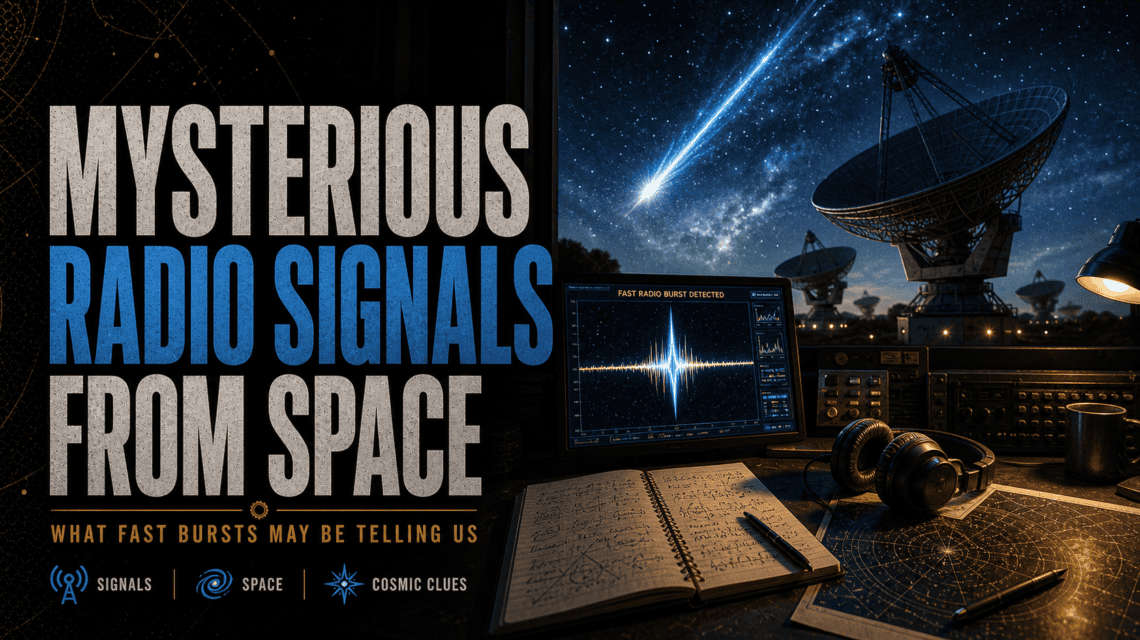
 Fast radio bursts, or FRBs, are among the most intriguing signals in modern astronomy: millisecond flashes of radio energy that arrive from across the universe and, in a single blink, can release as much energy as the Sun does in days. Here is what we actually know about them, and why researchers are so excited.
How the mystery began
The Lorimer burst
The first FRB was spotted in 2007 by Duncan Lorimer and his student David Narkevic, who found it buried in archival data from Australia’s Parkes radio telescope, recorded back in 2001. It was a single, intense pulse lasting only milliseconds. Its “dispersion measure,” the way its different frequencies arrived slightly staggered after crossing space, suggested it had traveled an enormous, extragalactic distance. For years it was so strange that some wondered whether it was even real.
Repeaters versus one-offs
Since then, hundreds more have been detected, and they fall into two broad camps. Most appear as one-off events that never repeat, while a minority, such as the well-studied FRB 121102, flash again and again, sometimes letting astronomers pinpoint their home galaxies. Whether the two types come from different sources or different circumstances is still being worked out.
Closing in on the source
A magnetar in our own galaxy
A major breakthrough came in April 2020, when telescopes including CHIME and STARE2 detected an FRB-like burst from SGR 1935+2154, a magnetar, a young neutron star with an extreme magnetic field, right inside our Milky Way. It was the first FRB-like signal traced to a specific object, and it strongly supports the idea that at least some FRBs come from magnetars. It did not close the case entirely, but it transformed the field.
Why FRBs are so useful
Beyond their mystery, FRBs are becoming tools. Because their signals are stretched by all the material they pass through on the way to Earth, they act as cosmic probes, and astronomers have used them to help locate the universe’s “missing” ordinary matter spread thinly between galaxies. A flash lasting a thousandth of a second can, in effect, weigh the space it crossed.
FRBs are one of several genuinely open puzzles in the sky. For the broader picture, see our guide to space mysteries scientists cannot explain yet.
Related Reading
Research Notes
- Pew Research Center
- Edison Research True Crime Consumer Report
- Google Trends Summergeist
- AP / Publishers Weekly best-seller list
Editorial note: Mad Over Stories prioritizes source-aware storytelling. For true crime and real-life topics, we avoid naming private individuals unnecessarily, distinguish confirmed facts from interpretation, and update articles when better information becomes available.
More From Mad Over Stories
You Might Also Like

Ancient Technology Discoveries That Make the Past Feel More Inventive

Best Science Books for Curious Adults Who Want Wonder Without Jargon

Scientific Discoveries Everyone Should Know Because They Changed Daily Life

Deep Ocean Mysteries: Why Earth's Largest Habitat Still Feels Alien
Space Mysteries Scientists Cannot Explain Yet, From Fast Signals to Dark Matter


1 Comment