 Mad Over Stories Team
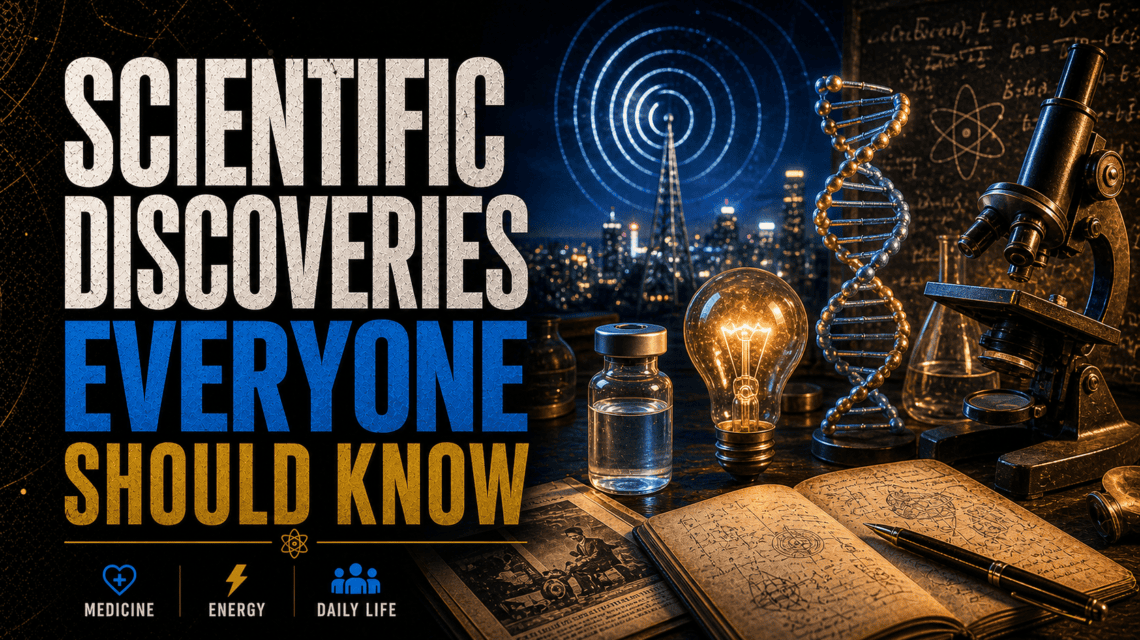
 A handful of scientific discoveries are so woven into modern life that we forget they were once hard-won breakthroughs. Each of the following quietly reshaped health, technology, or the food supply for billions of people. Here is what they are and why they still matter every day.
Discoveries that keep us healthy
Germ theory
For most of history, disease was blamed on bad air or imbalance. In the 19th century, work by Louis Pasteur and Robert Koch established that specific microorganisms cause specific diseases. That single idea gave us handwashing, sterilized instruments, food safety, water treatment, and antiseptic surgery, and it is arguably responsible for more saved lives than any other discovery on this list.
Vaccines
In 1796 Edward Jenner showed that exposure to cowpox protected people against deadly smallpox, launching the science of vaccination. Two centuries later, a global campaign using vaccines eradicated smallpox entirely, declared gone in 1980, the only human disease ever wiped out. Vaccines now prevent diseases that once routinely killed or disabled children.
The structure of DNA
In 1953 James Watson and Francis Crick, drawing crucially on Rosalind Franklin’s X-ray data and Maurice Wilkins’s work, described DNA’s double-helix structure. Understanding how genetic information is stored and copied underpins modern medicine, forensics, agriculture, and the genetic tests and therapies now entering everyday care.
Discoveries that power and feed the world
Electricity and electromagnetism
In the 1800s Michael Faraday showed that a changing magnetic field can generate electric current, and James Clerk Maxwell united electricity, magnetism, and light in a set of equations. That knowledge is the basis of every generator, motor, and radio wave, and therefore of the entire electrified, connected world we live in.
The transistor
Invented at Bell Labs in 1947 by John Bardeen, Walter Brattain, and William Shockley, the transistor is a tiny switch that controls electric current. Shrunk and packed by the billions onto chips, transistors run every computer, phone, and smart device on Earth. It is the single component that made the digital age physically possible.
The Haber-Bosch process
In the early 20th century, Fritz Haber and Carl Bosch developed a way to pull nitrogen from the air and turn it into ammonia for fertilizer. This unglamorous chemical process feeds an estimated half of the world’s population by boosting crop yields. Few discoveries have done more to sustain human numbers, even as its energy use and environmental costs are now widely studied.
To explore stories like these in depth, browse our list of science books for curious adults who want wonder without jargon.
Related Reading
Research Notes
- Pew Research Center
- Edison Research True Crime Consumer Report
- Google Trends Summergeist
- AP / Publishers Weekly best-seller list
Editorial note: Mad Over Stories prioritizes source-aware storytelling. For true crime and real-life topics, we avoid naming private individuals unnecessarily, distinguish confirmed facts from interpretation, and update articles when better information becomes available.
More From Mad Over Stories
You Might Also Like
Ancient Technology Discoveries That Make the Past Feel More Inventive

Mysterious Radio Signals From Space: What Fast Bursts May Be Telling Us
Best Science Books for Curious Adults Who Want Wonder Without Jargon
Deep Ocean Mysteries: Why Earth's Largest Habitat Still Feels Alien
Space Mysteries Scientists Cannot Explain Yet, From Fast Signals to Dark Matter