 Mad Over Stories Team
 Editor’s note: This is a narrative story published for entertainment. Names, details, and dialogue may be fictionalized or composited, and the story as told here should not be treated as verified reporting. See our Editorial & Content Policy.
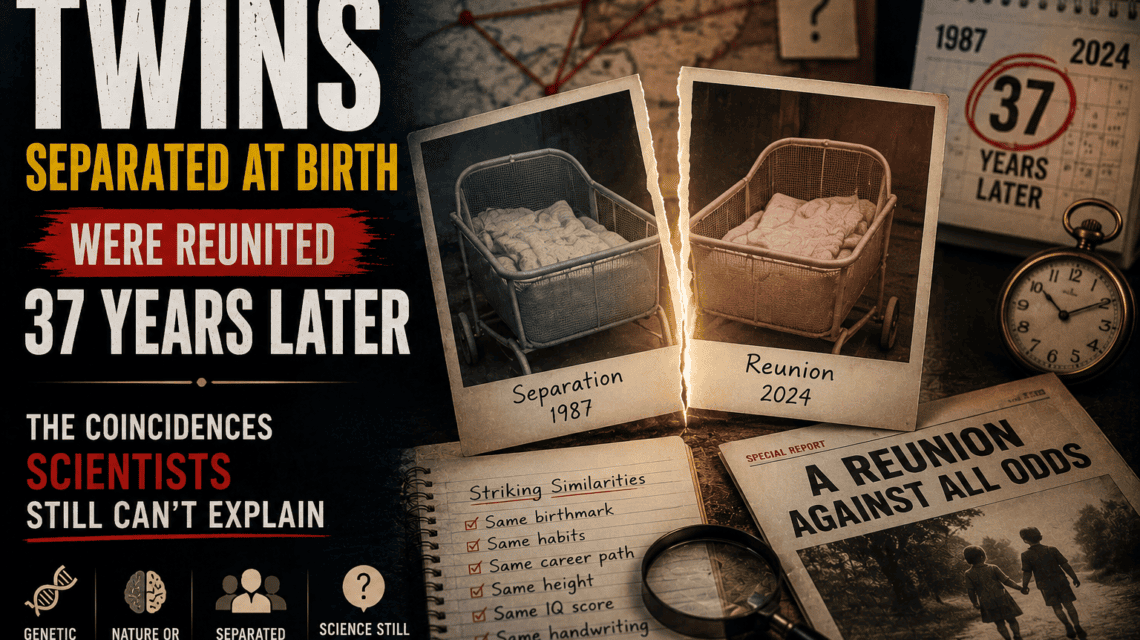
They had been born three minutes apart on a March morning in 1976 in a hospital in Seoul, South Korea. They were healthy, identical. Their birth mother was 19. She relinquished them for adoption through an agency that placed Korean children with families abroad — a common path in the 1970s.
The agency separated them. Nobody documented why.
One twin went to a family in Chicago. The other went to a family in Stockholm. They grew up 5,000 miles apart, speaking different languages, with no knowledge the other existed.
When they met, 37 years later, they had the same laugh.
Two Lives, One Blueprint
Annika S. was raised in Sweden. She was a nurse. She had two children, a methodical disposition, and a particular habit of drumming her fingers on surfaces when she was thinking. She had always known she was adopted from Korea. She had filed for genealogy searches twice and come up with nothing.
The other twin — who has kept her name private — was raised in Chicago. She was a registered nurse. She had one child. She drummed her fingers when she was thinking.
She had also filed for genealogy searches. Twice.
What DNA Testing Found
The match came in 2013, through a consumer DNA service both women had submitted to within three weeks of each other. The algorithm flagged them as identical twins with statistical confidence. The platform sent the notification. Both women received it on the same morning.

Annika called the number in the profile immediately. The phone rang for a long time.
When the other woman answered, they were both, independently, already crying.
Read more: the nurse who wrote the same word on 47 patient charts.
The Coincidences Researchers Documented
Their reunion attracted the attention of a team at the University of Minnesota that had for decades studied identical twins raised apart — one of the most significant research datasets in behavioral genetics. What the team documented in this case added to a body of evidence that continues to challenge intuitive assumptions about nature and environment.
Both women were registered nurses. Both had children of approximately the same age. Both had, at the same period in their mid-twenties, gone through a period of severe depression they had not sought treatment for. Both had overcome it through the same mechanism: structured exercise.
Both drummed their fingers. Both had the same laugh — not just similar, but matching in pattern, rhythm, and pitch. Both, independently, had decorated their children’s rooms in shades of green.
Both had dogs named variations of the same name.
What the Researchers Said
Dr. Nancy Segal, one of the foremost researchers on twins reared apart, has documented hundreds of such reunions. Her research consistently shows that identical twins raised apart demonstrate striking convergence in personality traits, cognitive patterns, occupational choices, and even life events.
The mechanism is genetic: identical twins share 100% of their DNA, and the behavioral expression of that shared genetics appears to be robust enough to survive dramatically different environmental inputs.
This doesn’t mean environment doesn’t matter. It means that the genetic contribution to behavior, personality, and even circumstantial life choices is far larger than most people — raised with a cultural emphasis on individual choice and self-determination — are comfortable acknowledging.
“People find it unsettling,” Dr. Segal has said, “because the implication is that much of what they think of as their choices might also be their nature.”
The Question the Story Won’t Answer
Annika and her twin have now known each other for over a decade. They speak regularly. They have visited each other. Their children — cousins who look like siblings — have met.
They have not, as of their last public statement, established why they were separated. The adoption agency closed decades ago. Records from that period are incomplete. Their birth mother has not been located.
The twins have stopped searching. They say they have enough.
Why Twin Reunion Stories Never Get Old
The ongoing public fascination with twins-reared-apart stories isn’t prurient curiosity. It’s philosophical vertigo. These stories force a confrontation with a question most people prefer not to sit with: what would you be like if you’d been raised differently?
The standard answer is: completely different. We are products of our environments, our choices, our experiences. We built ourselves.
Annika and her twin suggest otherwise. Two people, raised in different countries, different languages, different families — converging on the same profession, the same finger-drumming habit, the same laugh, dogs with the same name.

The philosophical vertigo this produces is not about twins. It’s about you.
Annika and her sister speak on video call every Sunday. They have not established a firm tradition of this — it simply happened, gradually, and then continued.
They are, their adult children have observed, extremely similar in the way they give advice. Direct, specific, and slightly more certain than the situation warrants. Both of them are right about it more often than not.
DNA testing has a way of producing revelations that the science can verify but can’t fully account for. One of the most striking recent examples: a woman whose recurring dream led her to a DNA test that changed everything she knew about her past. The test explained the connection. The dream remained unexplained.
The twins’ shared behaviors after decades apart raise questions about how much of identity is biological. A different angle on the same question: a woman who woke from surgery speaking French — a language she had never studied or visited. In both cases, the body appeared to know something the conscious mind didn’t.
Some findings produce more hesitation than publication. The deep-sea recording that researchers classified and held back from the scientific community is a documented case of that reluctance — eleven months between discovery and disclosure, with a paper trail for each week.
Patterns that appear in nature without obvious cause — and then get explained by something measurable that wasn’t being tracked — recur across disciplines. For six years, every animal avoided a specific stretch of road in Oregon before the cause was identified. What connects the story to this one isn’t the mystery but the gap: the years during which something was clearly happening, and no one had the framework to name it.
Some anomalies become more disorienting once they’re explained. A Swedish lake that turned blood red overnight turned out to be a case of collective biological response — an entire algae population entering a stress-protection mode simultaneously. The structural parallel with twin behavior data is uncomfortable: synchronized responses to shared conditions appear to be a feature of biological systems rather than an exception.

More From Mad Over Stories
You Might Also Like

Ancient Technology Discoveries That Make the Past Feel More Inventive

Mysterious Radio Signals From Space: What Fast Bursts May Be Telling Us

Best Science Books for Curious Adults Who Want Wonder Without Jargon
Scientific Discoveries Everyone Should Know Because They Changed Daily Life

Deep Ocean Mysteries: Why Earth's Largest Habitat Still Feels Alien