 Mad Over Stories Team
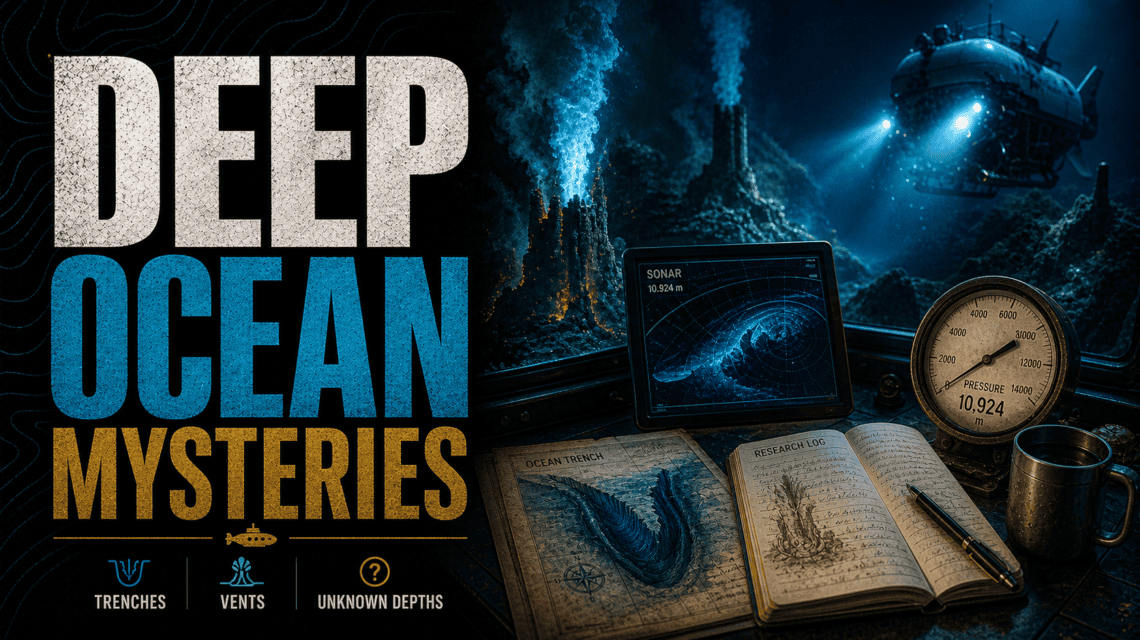
 The deep ocean is the largest living space on Earth, yet it remains one of the least explored places humans can reach. Sunlight fades to black a few hundred meters down, and below that lies a cold, crushing world we have barely sampled. Here is why Earth’s biggest habitat still feels alien.
Some links below are affiliate links. As an Amazon Associate, Mad Over Stories earns from qualifying purchases.
A place we have barely mapped
The hadal zone
The deepest part of the ocean, below about 6,000 meters, is called the hadal zone, named for Hades. It is found mainly in ocean trenches, and its deepest point, the Challenger Deep in the Mariana Trench, reaches nearly 11,000 meters, deep enough to swallow Mount Everest with room to spare. The pressure there is over a thousand times that at the surface, yet fish, amphipods, and microbes still live in it.
How little of the seafloor we have seen
Despite satellites giving us a rough gravity-based picture of the ocean floor, only around a quarter of it had been mapped in high resolution by the early 2020s. International efforts such as Seabed 2030 aim to change that, but for now we have better detailed maps of the surface of Mars and the Moon than of our own seabed. Most of the deep sea has never been seen by human eyes or cameras.
Life and sounds from the dark
The deep scattering layer’s daily migration
Sonar operators long puzzled over a “false bottom” that rose toward the surface at night and sank by day. It turned out to be a dense layer of small fish, squid, and plankton, and their nightly rise to feed and retreat to hide is the largest animal migration on the planet, happening every single day across the world’s oceans. It moves an enormous amount of carbon into the deep in the process.
Deep-sea gigantism
Many deep-sea animals grow startlingly large compared with shallow-water relatives, a pattern called deep-sea gigantism. Examples include the giant isopod, the Japanese spider crab, and the giant and colossal squids. Cold temperatures, scarce food, and high pressure seem to favor larger, slower-metabolizing bodies, though the full explanation is still debated.
Unexplained sounds
Hydrophones sometimes pick up loud ocean noises that take time to explain. The famous “Bloop” recorded in 1997 was eventually attributed by scientists to the cracking of massive icebergs, not a giant creature. That resolution is a good reminder of how the deep works: the sea generates genuinely strange signals, and careful science, rather than legend, usually finds the cause in the end.
Marine biologist Helen Scales captures the wonder and science of this realm beautifully in the book below.

The Brilliant Abyss
Marine biologist Helen Scales explores the deep sea's biology, mystery, and fragile future.
View on Amazon →Related Reading
Research Notes
- Pew Research Center
- Edison Research True Crime Consumer Report
- Google Trends Summergeist
- AP / Publishers Weekly best-seller list
Editorial note: Mad Over Stories prioritizes source-aware storytelling. For true crime and real-life topics, we avoid naming private individuals unnecessarily, distinguish confirmed facts from interpretation, and update articles when better information becomes available.
More From Mad Over Stories
You Might Also Like

Ancient Technology Discoveries That Make the Past Feel More Inventive

Mysterious Radio Signals From Space: What Fast Bursts May Be Telling Us

Best Science Books for Curious Adults Who Want Wonder Without Jargon

Scientific Discoveries Everyone Should Know Because They Changed Daily Life

Space Mysteries Scientists Cannot Explain Yet, From Fast Signals to Dark Matter

2 Comments