 Mad Over Stories Team
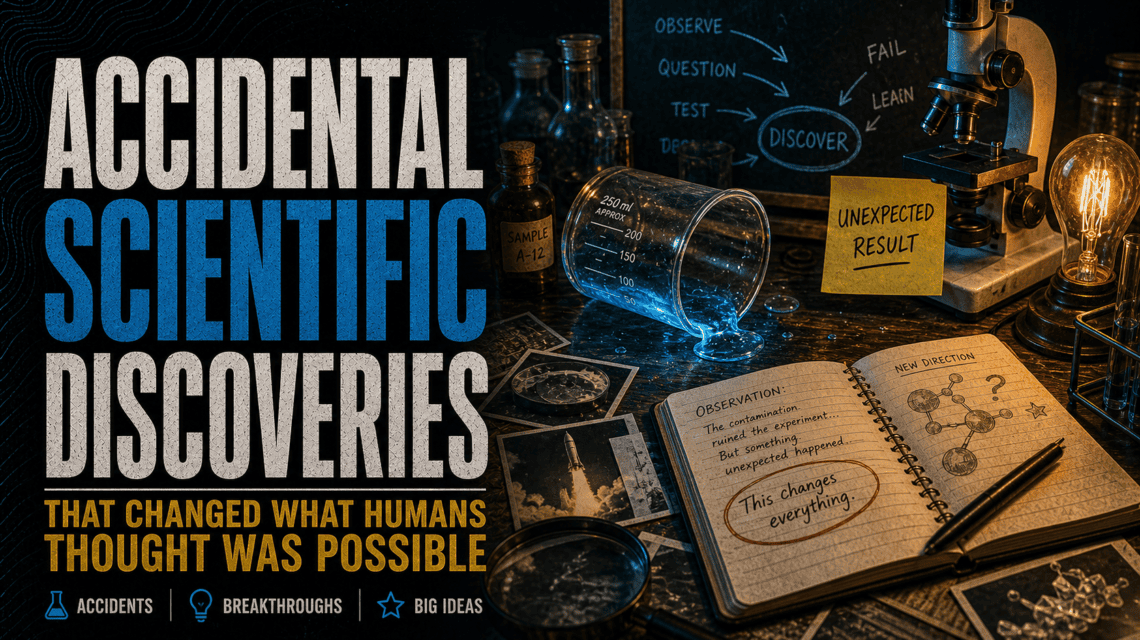
 Not every breakthrough starts with a plan. Some of the most important discoveries in modern science began with a spill, a stray observation, or an experiment that “failed” in an interesting way, and then a prepared mind that refused to look away. These are real cases where accident rewrote what people thought was possible.
Accidents that reshaped medicine
Penicillin and a contaminated dish
In 1928 the Scottish bacteriologist Alexander Fleming returned from holiday to find that a mold, Penicillium notatum, had drifted onto a plate of Staphylococcus bacteria and killed the colonies around it. He recognized that the mold was producing an antibacterial substance. It took a decade more, and the work of Howard Florey and Ernst Chain, to turn that observation into a usable drug, but antibiotics changed the odds of surviving infection for the entire species.
X-rays and a glowing screen
In 1895 the German physicist Wilhelm Rontgen was experimenting with a cathode-ray tube when he noticed a nearby fluorescent screen glowing even though the tube was shielded. He had stumbled onto an unknown, penetrating radiation he called “X” for unknown, and within weeks he had photographed the bones of his wife’s hand. Medicine gained the ability to see inside the living body without cutting it open, and Rontgen won the first Nobel Prize in Physics in 1901.
Radioactivity and a fogged photographic plate
In 1896 Henri Becquerel was studying whether uranium salts needed sunlight to emit rays. Clouds forced him to leave his samples in a drawer with wrapped photographic plates. When he developed the plates anyway, they were fogged, proving the uranium emitted radiation entirely on its own. That accident opened the door to Marie and Pierre Curie’s work and to our whole understanding of the atom.
Accidents that reshaped everyday life
The microwave oven and a melted candy bar
While testing magnetrons for radar at Raytheon in 1945, engineer Percy Spencer noticed a chocolate bar melting in his pocket. Curious, he aimed the device at popcorn kernels and then an egg, and grasped that microwaves could heat food from the inside. The kitchen appliance that resulted now sits in most homes on Earth.
Vulcanized rubber and a hot stove
Charles Goodyear spent years trying to make natural rubber stable in heat and cold. The decisive moment, around 1839, reportedly came when he accidentally dropped a mixture of rubber and sulfur onto a hot stove and found it charred into a tough, weatherproof material instead of melting. Vulcanization made durable tires, seals, and countless products possible.
The Post-it Note and a glue that failed
In 1968 the 3M chemist Spencer Silver invented an adhesive that was too weak to be useful, sticky enough to hold but easy to peel away. It sat as a solution without a problem until colleague Art Fry, frustrated by bookmarks falling out of his church hymnal, realized the weak glue was perfect for repositionable notes. The “failure” became a global office staple.
The pattern across all of these is not luck alone but attention. As Louis Pasteur put it, chance favors the prepared mind. If you enjoy this angle, we go deeper in 12 Scientific Discoveries Made Completely by Accident, a companion piece with more short case studies.
Related Reading
Research Notes
- Pew Research Center
- Edison Research True Crime Consumer Report
- Google Trends Summergeist
- AP / Publishers Weekly best-seller list
Editorial note: Mad Over Stories prioritizes source-aware storytelling. For true crime and real-life topics, we avoid naming private individuals unnecessarily, distinguish confirmed facts from interpretation, and update articles when better information becomes available.
More From Mad Over Stories
You Might Also Like
Ancient Technology Discoveries That Make the Past Feel More Inventive

Mysterious Radio Signals From Space: What Fast Bursts May Be Telling Us
Best Science Books for Curious Adults Who Want Wonder Without Jargon
Scientific Discoveries Everyone Should Know Because They Changed Daily Life
Deep Ocean Mysteries: Why Earth's Largest Habitat Still Feels Alien


2 Comments