 Mad Over Stories Team
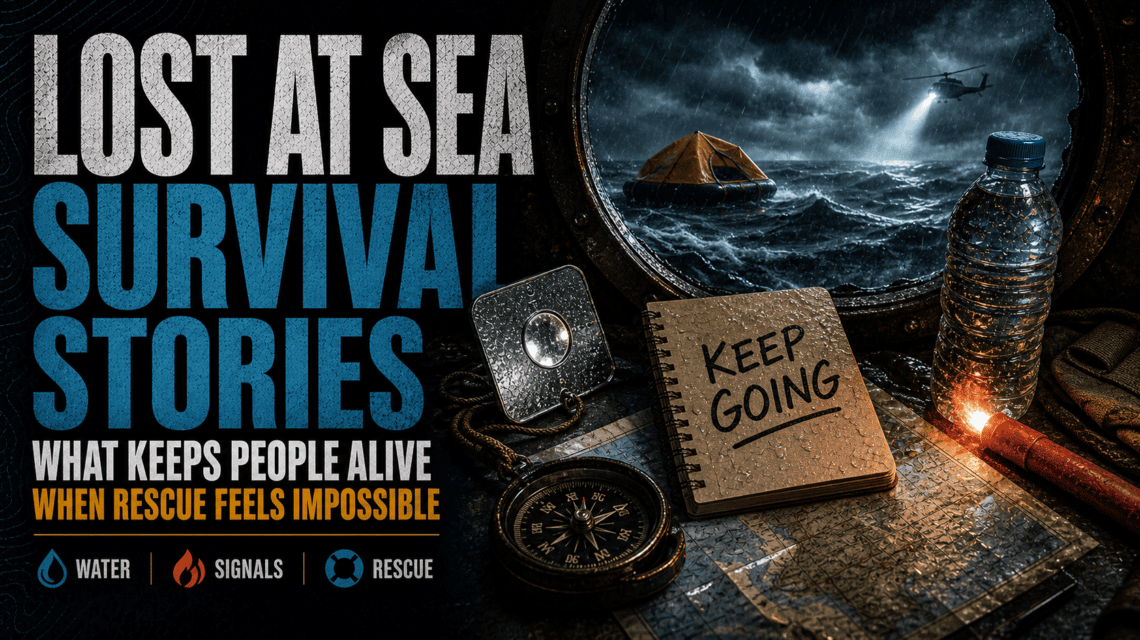
 Open-ocean survival is a slow-motion emergency. There is no cliff to climb down and no forest to walk out of, only water, sun, and time. People who have survived weeks or months adrift almost never credit heroics. They credit discipline: rationing water to the drop, staying with their raft, and building small daily routines that held panic at bay. Their stories share a surprisingly practical set of habits that anyone can learn from.
Some links below are affiliate links. As an Amazon Associate, Mad Over Stories earns from qualifying purchases.
Poon Lim: 133 Days on a Wooden Raft
In November 1942, the British merchant ship SS Ben Lomond was torpedoed in the Atlantic, and Chinese sailor Poon Lim found himself alone on a small wooden life raft. Over the next 133 days he collected rainwater in a canvas cover, caught fish with a hook fashioned from a torch spring, and even snared a passing bird. He forced himself to swim briefly each day to stay strong enough to climb back aboard. Brazilian fishermen finally picked him up near the coast. His 133 days remains one of the longest recorded solo survivals adrift, and it was built almost entirely on improvisation and rationing.
Steven Callahan: 76 Days and a Notebook Full of Discipline
In 1982, naval architect Steven Callahan was sailing solo across the Atlantic when his sloop, the Napoleon Solo, sank after a nighttime collision, probably with a whale. He spent 76 days in a five-foot inflatable raft, spearing fish with a modified speargun and coaxing fresh water from solar stills he had to nurse constantly. He tracked his position, rationed obsessively, and kept a log to keep his mind ordered. His memoir Adrift is one of the most detailed survival accounts ever written, precisely because he treated the ordeal as an engineering problem to be managed hour by hour.
José Salvador Alvarenga: 438 Days Across the Pacific
The longest solo survival adrift on record belongs to Salvadoran fisherman José Salvador Alvarenga. In late 2012 a storm blew his small boat off the coast of Mexico, and he drifted roughly 6,000 miles across the Pacific before washing ashore in the Marshall Islands in early 2014. He survived by catching fish, turtles, and seabirds with his bare hands, drinking rainwater and, when there was none, turtle blood. His story, told in Jonathan Franklin’s book 438 Days, is a study in the sheer stubbornness required to keep eating, drinking, and hoping long after any reasonable person would have quit.
What the Survivors Did Right
Across these accounts, the same habits recur. First, water discipline: survivors never drink seawater, because its salt accelerates dehydration and hastens death. They ration fresh water and harvest every drop of rain. Second, staying with the wreckage or raft: a raft is bigger, more visible, and slower to lose than a swimmer, and it carries whatever supplies remain. Third, mental routines: keeping a log, counting the days, fishing on a schedule, or simply refusing to imagine the worst. The Baileys, an English couple who survived 117 days in the Pacific in 1973, and Tami Oldham Ashcraft, who survived 41 days after a hurricane in 1983, describe the same anchor. Small, repeatable tasks kept despair from taking over. In open water, the enemy is as much the mind as the sea.

Adrift: Seventy-Six Days Lost at Sea
Callahan's classic firsthand account of surviving 76 days alone on a life raft in the Atlantic, rich with the practical detail that makes it a survival-writing benchmark.
View on Amazon →For more, see our guide to the best survival books.
Related Reading
Research Notes
- Pew Research Center
- Edison Research True Crime Consumer Report
- Google Trends Summergeist
- AP / Publishers Weekly best-seller list
Editorial note: Mad Over Stories prioritizes source-aware storytelling. For true crime and real-life topics, we avoid naming private individuals unnecessarily, distinguish confirmed facts from interpretation, and update articles when better information becomes available.
More From Mad Over Stories
You Might Also Like





1 Comment