 Mad Over Stories Team
Human beings have survived things that should have killed them. Trapped in jungles for weeks. Adrift on the ocean for months. Buried alive under avalanches. Left for dead on the side of Everest. These aren’t inspirational metaphors — they’re documented cases of real people who refused to die when every physical circumstance said they should.
What separates survivors from victims? It’s not always strength, or luck, or training. The answer is more complex — and more fascinating — than any single factor.
The Psychology of Survival
Before diving into the stories themselves, it’s worth understanding what researchers have found about survival psychology. Lawrence Gonzales, author of Deep Survival, spent decades studying who survives extreme situations and who doesn’t. His findings are counterintuitive.
The key factors aren’t what you’d expect:
- Calm beats panic. The first response most people have in a crisis — frantic movement, desperate attempts to escape — consumes energy and impairs judgment. Survivors slow down, assess, then act.
- Small goals beat big ones. Survivors don’t focus on “get rescued.” They focus on “get through the next hour.” The mental task of survival is broken into manageable pieces.
- Purpose matters more than skill. People with a reason to survive — a child waiting at home, a mission to complete — survive at higher rates than those without. Purpose generates endurance.
- Acceptance is not giving up. Survivors often describe accepting the possibility of death as a turning point — not because they stopped fighting, but because accepting the worst freed them to act clearly.
Read more: the nurse whose single word on 47 patient charts changed everything.
Read more: the woman who woke from surgery speaking perfect French and what science said.
To understand why some people survive the impossible, read this:

Deep Survival
The science of who lives, who dies, and the surprising reasons why.
View on Amazon →Yossi Ghinsberg: Lost in the Amazon for 40 Days
What happened: In 1981, Israeli backpacker Yossi Ghinsberg joined three strangers for an expedition into the Bolivian Amazon. What was supposed to be an adventure became a survival crisis when the group became separated. Ghinsberg and one companion split off from the other two; soon after, even that pair lost each other, leaving Ghinsberg completely alone.
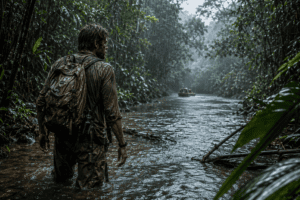
The conditions: Dense Amazon rainforest, no survival training, minimal equipment. Insects. Predators. Flooding rivers. Hallucinations from hunger and isolation. A jaguar that stalked him for days.
How he survived 40 days:
- Used fire as both warmth and signal (bow-drill technique learned from observing locals)
- Followed rivers downstream (the logic: water flows to civilization)
- Ate wild fruit, insects, anything edible
- Created a mental routine — structure prevented despair
- Maintained belief that rescue was possible
The rescue: River guides spotted him from their boat. He had lost 36 pounds. The jaguar tracks around his camp suggested the animal had circled him multiple times without attacking.
The lesson: Following water was Ghinsberg’s lifeline. In survival situations, rivers almost always lead toward human settlements. His story became the film Jungle (2017) starring Daniel Radcliffe.
Juliane Koepcke: The Only Survivor of LANSA Flight 508
What happened: On December 24, 1971, LANSA Flight 508 was struck by lightning over Peru and broke apart at 10,000 feet. All 91 passengers and crew died — except 17-year-old Juliane Koepcke, daughter of two scientists who had spent years in the Amazon.
How she survived the fall: She was still strapped in her seat row when the plane broke apart. Seated rows act as crude parachutes — the drag slows descent. She fell through the jungle canopy (which absorbed impact) and landed in soft earth.
Surviving 11 days alone in the jungle:
- Her father had taught her to follow any water source downstream
- She found a small stream and waded downstream for 9 days
- Avoided leeches and caimans; treated a festering wound with gasoline she found at a riverbank shelter
- Ate nothing (couldn’t identify safe food); survived on a bag of candy from the crash
The rescue: She reached a hut used by local loggers, found a motor, and waited. The loggers returned and took her to safety.
The lesson: Specific knowledge saved her. She knew to follow water. She knew which plants to avoid. She knew gasoline kills maggots. Her parents’ field experience, absorbed over years, became survival tools in a crisis she couldn’t have anticipated.
Aron Ralston: 127 Hours Beneath a Boulder
What happened: On April 26, 2003, rock climber Aron Ralston was descending a narrow slot canyon in Blue John Canyon, Utah, when an 800-pound boulder dislodged and pinned his right forearm against the canyon wall.
The situation: Alone. No phone signal. Told no one where he was going. Food and water for a day. Five days passed.
What he tried first:
- Chipping at the boulder with his multi-tool (no effect)
- Using his climbing gear as a pulley (couldn’t move it)
- Waiting for rescue (no one was looking)
The decision: On day five, facing death by dehydration, Ralston made the decision that made him famous. He broke the bones in his trapped arm against the boulder wall, then used his multi-tool — a cheap blunt-edged tool not designed for surgery — to amputate his own forearm.
What followed: He rappelled 65 feet down the canyon, hiked 8 miles out, and was spotted by a family on vacation who called for help. A rescue helicopter reached him before he reached the trailhead.
The lesson: Ralston’s survival required accepting an outcome most people can’t contemplate. His decision to amputate was rational — it was the only option — but rationality requires overcoming the instinct to protect the body from harm. His story was adapted into Danny Boyle’s film 127 Hours (2010).
Beck Weathers: Left for Dead on Everest
What happened: The 1996 Everest disaster is the deadliest single day in the mountain’s recorded history. Caught in a catastrophic blizzard at 26,000 feet, Beck Weathers — a Texas pathologist with no exceptional mountaineering background — was left for dead. Twice.
The situation: Severe hypothermia. Snow blindness (he’d developed a photoreceptor condition at altitude that destroyed his vision). Frostbite beginning in his hands and face. Abandoned at 26,000 feet with no shelter as the storm raged.
The recovery that shouldn’t have happened: After lying unconscious and presumed dead for hours, Weathers regained consciousness — alone, near-blind, temperature dropping. He described a vision of his family that provided the will to move. He stood and walked into Camp Four.
The high-altitude helicopter rescue: His survival triggered the highest-altitude helicopter rescue in history at the time, with a Nepalese pilot landing at 19,900 feet in conditions previously considered impossible.
The aftermath: Weathers lost his right hand, four fingers on his left, his nose, and parts of both feet to frostbite. He considers it worth it.
The lesson: Weathers himself calls it willpower, but researchers who’ve studied his case point to something more specific: his vision of his family created a specific, emotionally charged goal. The brain, it seems, can overcome remarkable physical limitations when survival is tied to something beyond the self.
Steven Callahan: 76 Days Adrift in the Atlantic
What happened: In January 1982, sailor Steven Callahan was 800 miles west of the Canary Islands when his sloop Napoleon Solo struck an unknown object and sank in 15 minutes. He escaped into a 5-foot inflatable life raft with a sleeping bag, some water, and emergency equipment.
The situation: No distress signal received. Three ships passed without seeing him. He survived 76 days at sea — the longest solo survival on a life raft in recorded history at the time.
How he survived 76 days:
- Water: Solar still (uses sunlight to evaporate and condense saltwater) plus rain collection. Ration: 1–2 cups per day.
- Food: Speared dorado (mahi-mahi) and triggerfish using improvised spears. Ate raw.
- Physical management: Exercised to prevent muscle atrophy; managed solar exposure carefully.
- Mental discipline: Kept a detailed log — both practical (raft status, food supply) and emotional (despair, hope). The act of recording became an anchor to sanity.
- Goal-setting: Set targets: reach the shipping lanes, survive to next week, repair the raft.
The rescue: A fishing vessel spotted him near Guadeloupe on April 21, 1982. He had drifted 1,800 miles.
The lesson: Callahan’s survival manual, Adrift: Seventy-Six Days Lost at Sea, has become required reading for offshore sailors. His core finding: the difference between surviving and perishing isn’t equipment — it’s the decision to keep trying when logic says the outcome is hopeless.
The Teenage Girl in the Amazon: Juliane Koepcke Revisited
Koepcke’s story deserves additional consideration because it demonstrates something researchers now consider one of the most critical survival factors: embedded knowledge.
She didn’t survive because she was trained for the jungle. She survived because her parents — biologists who had spent years in the Amazon — had, over her childhood, embedded knowledge in her that she didn’t know she had until she needed it.
Follow the water. Don’t eat what you can’t identify. Gasoline kills parasites. These aren’t dramatic survival decisions. They’re small, specific facts absorbed through proximity to expertise over years.
The implication: The most valuable survival preparation isn’t dramatic (a weekend course, emergency gear). It’s accumulated knowledge from sustained exposure to the environments and skills that matter.
Read more: the teenage girl who survived 11 days alone in the Amazon after the plane went down.
Common Patterns Across Survival Stories
Researcher Dr. John Leach at Portsmouth University studied hundreds of survival cases and found consistent patterns:
The 10-80-10 rule:
- 10% of people in extreme situations act appropriately and decisively
- 80% become immobilized — not panicking, but frozen, unable to process what’s happening
- 10% do destructive things (panic, run, make situations worse)
The 10% who act calmly and decisively share traits: prior training (even informal), clear purpose, and the habit of breaking large problems into small ones.
Shared survivor traits:
- Emotional regulation: Not absence of fear, but the ability to act despite it
- Improvisation: Using available materials in unintended ways
- Long-term thinking under short-term pressure: Preserving resources (water, calories, energy) rather than consuming them
- Narrative construction: Creating a story about why survival matters and how the rescue happens
- Physical fitness: Not elite fitness, but baseline reserves to draw from
Read more: impossible survival stories of real people who refused to give up.
Read more: true stories with endings nobody predicted.
What These Stories Tell Us About Human Capacity
The most consistent finding across extreme survival cases is that the body can endure far more than we believe — if the mind allows it.
Ghinsberg spent 40 days in the Amazon on almost no food, and the primary damage was psychological: the fear, the isolation, the uncertainty. Once rescued, physical recovery took days. Psychological recovery took much longer.
Callahan survived 76 days at sea through meticulous mental discipline — the log he kept wasn’t just record-keeping. It was an external structure that gave shape to time when time had become meaningless.
Ralston amputated his own arm not because he was unusually fearless, but because he had methodically exhausted every alternative. His decision was the product of five days of rational analysis, not a moment of dramatic courage.
These stories reveal a truth that’s simultaneously uncomfortable and hopeful: we likely don’t know what we’re capable of until circumstances demand it.
Lessons Worth Keeping
You don’t need to be a survivalist to internalize what these cases demonstrate:
- Build baseline knowledge of your environment. What’s edible. What’s drinkable. Which direction is civilization.
- Practice staying calm under low-stakes discomfort. Cold showers. Physical challenges. Short periods without distraction. These train the nervous system to tolerate stress without panic.
- Set specific, small goals under pressure. Not “survive” — but “get through the next hour” or “reach the next ridge.”
- Tell someone where you’re going. Ralston’s critical mistake was not telling anyone his plans. Rescue requires rescuers who know to look.
The gap between survival and perishing is often not physical capacity. It’s the decision — made under pressure, with incomplete information — to keep trying.
📚 Keep reading: our guide to the best survival books.
More From Mad Over Stories
Frequently asked questions
What do these survival stories have in common?
Across every case, survivors describe the same core pattern: they controlled panic, broke an overwhelming situation into small, doable tasks, and held on to a reason to keep going. Researchers who study survival psychology consistently find that a calm, problem-solving mindset matters as much as physical strength or luck.
Who survived the longest alone in these stories?
Steven Callahan survived 76 days adrift in the Atlantic Ocean in 1982 after his sloop sank, drifting roughly 1,800 nautical miles in a life raft before fishermen rescued him near Guadeloupe — one of the longest documented solo survivals at sea.
Did Juliane Koepcke really survive a plane crash?
Yes. In 1971, 17-year-old Juliane Koepcke was the sole survivor of the LANSA Flight 508 crash over the Peruvian Amazon. She fell thousands of feet still strapped into her seat, then walked and waded through the rainforest for about 11 days before reaching help.
What did Aron Ralston do to survive?
While canyoneering alone in Utah’s Bluejohn Canyon in 2003, Aron Ralston was pinned when a boulder crushed his right forearm. After five days trapped, he amputated the arm with a multitool to free himself, then rappelled down and hiked out — the events dramatized in the film 127 Hours.
Are these survival stories true?
Yes. Each is a documented real event, recorded in survivors’ own memoirs, news reporting, and official investigations — including Yossi Ghinsberg’s account of three weeks lost in the Bolivian Amazon and Beck Weathers’s survival on Everest in 1996.
You Might Also Like