 Mad Over Stories Team
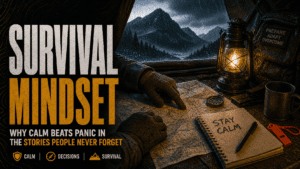
 The most gripping survival stories almost always turn on a single moment: a choice made in seconds that decided whether someone lived or died. Long before rescue arrives, an ordinary person has to look at an impossible situation and pick a course of action, often with broken bones, freezing hands, or no map. What separates the people who make it is rarely raw strength. It is the willingness to decide, and to keep deciding, when doing nothing feels safer.
Grouping these stories by the kind of decision involved reveals a pattern. Survival hinges on acting on yourself, trusting what you know over what you feel, and knowing when to move versus when to stay.
The Decision to Act on Yourself
Some situations leave no one to save you but you. In April 2003, canyoneer Aron Ralston was hiking alone in Blue John Canyon, Utah, when an 800-pound boulder shifted and pinned his right forearm against the wall. He was trapped for roughly five days with a liter of water and no way to signal for help. When he finally accepted that he would die there, he broke the two bones in his forearm and cut through the arm with a dull multi-tool, then rappelled down a wall and hiked out until he met other hikers. His story became the book Between a Rock and a Hard Place and the film 127 Hours. The lesson is brutal but clear: the hardest decisions are the ones you have to make against your own body.
The Decision to Trust What You Know Over What You Feel
Panic pushes people toward the wrong instinct. Survivors override it with knowledge. In December 1971, 17-year-old Juliane Koepcke was aboard LANSA Flight 508 when it broke apart in a thunderstorm over the Peruvian Amazon. Still strapped into her seat, she fell roughly two miles into the rainforest and survived with a broken collarbone and a gash on her arm. Her father, a biologist, had once told her that following moving water downstream leads to larger streams and, eventually, to people. Ignoring the instinct to stay put and wait, she waded down a creek for about 11 days until she reached a boat and shelter belonging to loggers. Her survival was not luck alone; it was a teenager choosing a remembered fact over her fear.
The Decision to Move, or to Stay Put
The move-or-stay choice is one of the most consequential in the outdoors, and the right answer depends entirely on the situation. Search-and-rescue experts generally advise staying with a vehicle or a large, visible shelter, because it is far easier for searchers to spot a car than a person, and because moving burns the energy and water you cannot replace. The Kim family case in December 2006 shows why. Stranded on a snowbound logging road in southern Oregon, the family waited with their car while James Kim eventually set out on foot to find help. His wife and daughters stayed with the vehicle and were rescued; James died of hypothermia in the wilderness. It is a heartbreaking illustration that moving is not always braver or smarter, and that the safest choice is often the patient one.
Why Split-Second Choices Decide Everything
Researchers who study survival keep returning to the same finding: the people who live tend to be the ones who act decisively and early, while hesitation compounds. Under acute stress the brain narrows its focus, a phenomenon often called cognitive tunneling, and many people freeze rather than choose. That freeze can be fatal in a fire, a flood, or fast-moving water where the window to escape is measured in seconds. The survivors in these stories were not fearless. They felt the same terror as anyone. What set them apart was the ability to accept a grim reality quickly, pick the least-bad option, and commit to it before the moment closed.
Related Reading
- Weird Survival Stories The Most Incredible Tales Of Human Resilience Against All Odds
- Best Survival Books of All Time
- Mountain Survival Stories: Why Small Mistakes Become Big Problems Above the Tree Line
- Miracle Rescue Stories: How Search Teams Turn Tiny Clues Into Lifelines
Research Notes
- Pew Research Center
- Edison Research True Crime Consumer Report
- Google Trends Summergeist
- AP / Publishers Weekly best-seller list
Editorial note: Mad Over Stories prioritizes source-aware storytelling. For true crime and real-life topics, we avoid naming private individuals unnecessarily, distinguish confirmed facts from interpretation, and update articles when better information becomes available.
More From Mad Over Stories
You Might Also Like