 Mad Over Stories Team
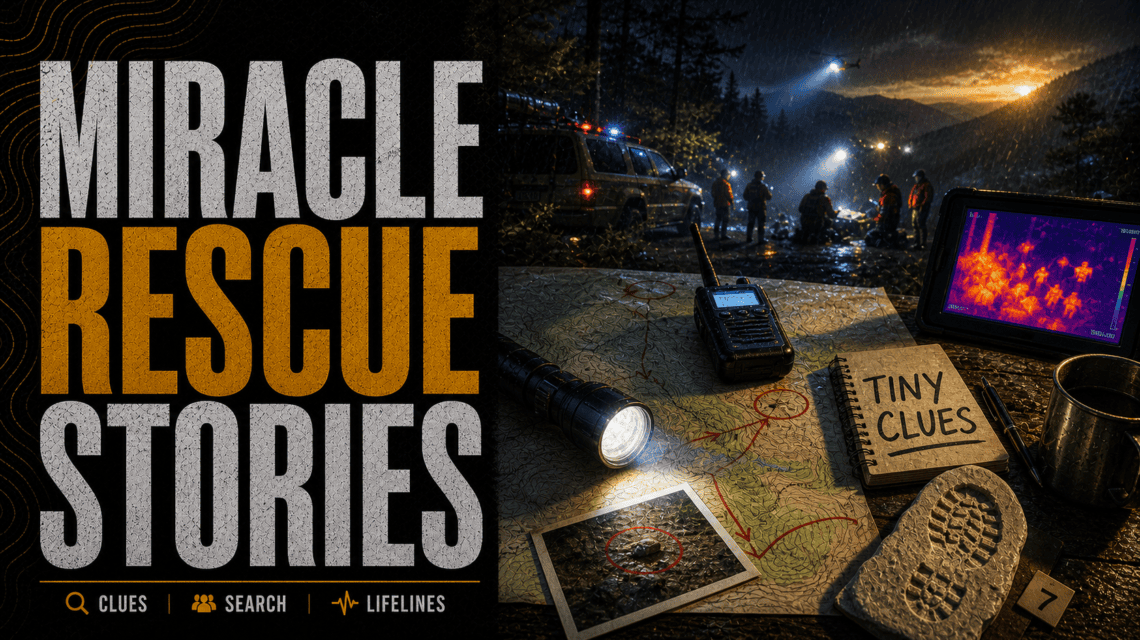
 The stories that make headlines are the rescues that look like miracles: a hiker found after a week, a child pulled from the woods, a downed plane located in a vast ocean. But search and rescue is not luck. It is a disciplined process that turns tiny, ordinary clues into a shrinking circle on a map. Understanding how searchers actually think makes those recoveries feel less like miracles and more like the payoff of good method.
It Starts With the Last Known Point
Every search begins at the Point Last Seen or Last Known Position: the final confirmed location of the missing person. From there, teams build a probability area, because people do not scatter randomly. Decades of data, compiled most famously in Robert Koester’s Lost Person Behavior, show that different types of people move in predictable ways. Lost hikers often continue downhill or follow trails and drainages; small children tend to stay closer and may hide; people with dementia frequently travel in a straight line until they are blocked by an obstacle. Searchers use these statistical ranges to decide where a person is most likely to be within the first hours.
Probability Grids and the Math of Searching
Modern search planning borrows from formal search theory. Managers divide the terrain into segments and assign each a probability that the person is there, then track Probability of Detection: the odds that searchers would have found the person if they were in that segment. A segment searched once at 50 percent detection is not “cleared.” It simply has a lower remaining probability, and teams may return. This is Bayesian reasoning in the field, the same logic used to locate the wreck of Air France Flight 447 in the Atlantic in 2011 and, decades earlier, the lost submarine USS Scorpion. You combine imperfect clues, weight them, and let the math point you toward the highest-probability ground.
Cell Phones, Scent, and Modern Clues
Technology has transformed the tiny-clue problem. A single cell-phone ping to a tower, or a text that briefly connects, can collapse a search area from hundreds of square miles to a few. Rescuers increasingly work with carriers and phone forensics to pull a last-connection location, and a phone that pings even weakly can define a search corridor. Scent-trained dogs add another dimension: trailing dogs follow the specific scent from an article of the missing person’s clothing, while air-scent dogs work a broad area for any human scent carried on the wind. A dropped glove, a footprint in mud, a candy wrapper, or a broken branch can each reset the probability map and redirect the whole operation.
Containment, Hasty Teams, and Racing the Clock
In the first hours, managers set up containment, positioning people at trailheads, roads, and ridgelines so a mobile subject cannot slip out of the search area unnoticed. Fast, light “hasty teams” sweep the highest-probability spots first: trails, water sources, and obvious hazards. Speed matters because survivability drops with exposure, especially in cold or heat, and because a person who is still moving makes the probability map go stale. The recoveries that feel miraculous are usually the ones where searchers read the clues correctly early, concentrated their effort on the right ground, and got there before time ran out.
Related Reading
- Weird Survival Stories The Most Incredible Tales Of Human Resilience Against All Odds
- Best Survival Books of All Time
- Incredible Survival Stories and the Split-Second Decisions That Changed Everything
- Mountain Survival Stories: Why Small Mistakes Become Big Problems Above the Tree Line
Research Notes
- Pew Research Center
- Edison Research True Crime Consumer Report
- Google Trends Summergeist
- AP / Publishers Weekly best-seller list
Editorial note: Mad Over Stories prioritizes source-aware storytelling. For true crime and real-life topics, we avoid naming private individuals unnecessarily, distinguish confirmed facts from interpretation, and update articles when better information becomes available.
More From Mad Over Stories
You Might Also Like