 Mad Over Stories Team
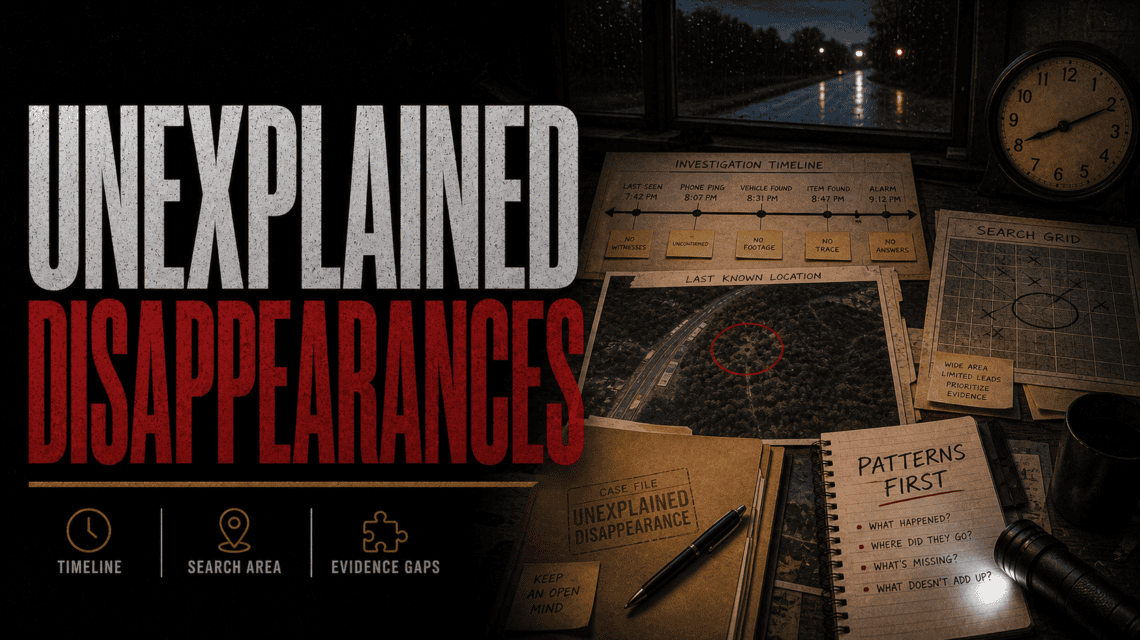
 When someone vanishes without an obvious explanation, investigators do not start with theories. They start with the last provable moment the person was alive and accounted for, and they build outward from there. The work is less about intuition than about method: fixing a point in time and space, reconstructing the hours around it, and testing every assumption against physical and digital evidence.
Understanding those patterns is what separates a careful reader of a missing-persons case from a rumor-driven one. Here is how professional searchers actually approach the problem.
The last known point anchors everything
The single most important fact in any disappearance is the “last verified sighting” — the most recent moment the person was confirmed to be somewhere by reliable evidence, not by memory or assumption. That might be a timestamped CCTV frame, a card transaction, a cell-tower connection, or a call logged to the second. Everything before that point is background; everything after it is the search. In the 2006 disappearance of Ohio State student Brian Shaffer, investigators had him on a bar’s security camera entering, but never captured him leaving on the exit footage — an anchor point so tight, and so strange, that the case remains unsolved to this day. The last known point defines the geography of the search and the list of people who need to be accounted for.
Reconstructing the timeline hour by hour
Once the anchor is set, investigators build a minute-by-minute timeline in both directions. They pull phone records, financial data, license-plate reader hits, and digital breadcrumbs from apps and messages, then cross-check each against witness accounts. The goal is to find the gaps — the stretches no one can explain. A person who is behaving normally leaves a dense, consistent trail; a break in that pattern (a phone that suddenly goes dark, a route that makes no sense, a withdrawal out of character) is where the case usually turns. Digital evidence has become so central that a stationary phone or a canceled ride can reshape an entire investigation.
Why the first 48 hours carry so much weight
The urgency around the “first 48” is not a television invention; it reflects how quickly evidence decays. Surveillance footage is overwritten on short loops, weather erases physical traces, scent trails weaken, and — critically — human memory degrades fast and grows less reliable as witnesses talk to one another and absorb outside information. In those early hours, searchers move quickly to preserve footage, interview witnesses separately, and secure the last known location before it changes. A delay of even a day can quietly close doors that never reopen.
Behavioral evidence: voluntary or not
Adults have the legal right to walk away from their lives, so one of the first questions is whether a disappearance was chosen. Investigators build what is sometimes called a lifestyle or victimology profile: Did the person take identification, medication, a passport, or cash? Were their plans, finances, and relationships consistent with someone intending to leave, or abruptly interrupted? A packed bag and a drained account suggest one story; medication left behind and a car abandoned mid-journey suggest another. This is also where searchers weigh risk factors — health conditions, mental-health crises, or dangerous circumstances that make a voluntary explanation less likely.
Terrain, staging, and the patterns that redirect a case
Physical setting shapes everything. Search-and-rescue teams treat wilderness, water, and urban disappearances as fundamentally different problems, grid-searching terrain and modeling how far a person could plausibly travel. The 2004 case of New Hampshire student Maura Murray — whose car was found abandoned after a minor crash on a rural road, with no confirmed sighting since — shows how terrain and a fixed last-known point can define a search that still, years later, resists resolution. Investigators also watch for staging: a scene arranged to look like something it is not. When the physical evidence and the assumed narrative stop agreeing, good investigators follow the evidence and let the theory go.
Related Reading
Research Notes
- Pew Research Center
- Edison Research True Crime Consumer Report
- Google Trends Summergeist
- AP / Publishers Weekly best-seller list
Editorial note: Mad Over Stories prioritizes source-aware storytelling. For true crime and real-life topics, we avoid naming private individuals unnecessarily, distinguish confirmed facts from interpretation, and update articles when better information becomes available.
More From Mad Over Stories
You Might Also Like
Books Like Verity: 7 Twisty Psychological Thrillers to Read Next
People Found Alive Years After Going Missing

Strange Deep Sea Discoveries That Prove the Ocean Still Has Secrets

Mysterious Discoveries Found Underground: Why Hidden Spaces Fascinate Us

Best Locked-Room Mystery Books for Readers Who Love Impossible Crimes