 Mad Over Stories Team
 We have mapped the surface of Mars in finer detail than we have mapped our own seafloor. The deep ocean — cold, dark, and under crushing pressure — is the largest habitat on Earth and still the least explored, which is why nearly every serious expedition returns with something science did not expect. The “secrets” here are not supernatural; they are the ordinary, astonishing consequences of a place we have barely visited.
Hydrothermal vents and life without sunlight
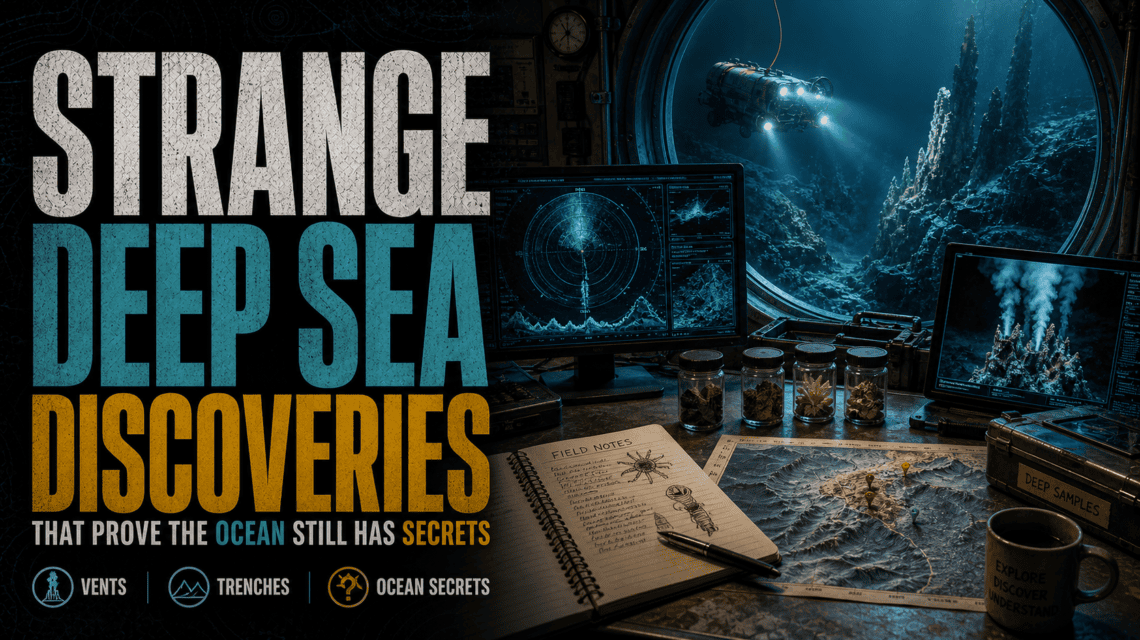
In 1977, scientists aboard the submersible Alvin exploring the Galápagos Rift found something that rewrote biology: dense communities of clams, tubeworms, and crabs thriving in total darkness around mineral-rich vents on the seafloor. The discovery revealed chemosynthesis — bacteria that build energy from chemicals like hydrogen sulfide venting from the crust, rather than from sunlight. It meant an entire food web could exist with no connection to the sun at all, a finding that reshaped where scientists think life might survive, on this planet and potentially on icy moons elsewhere.
The anglerfish and the economy of the deep
Few animals capture the strangeness of the deep like the deep-sea anglerfish. Females carry a bioluminescent lure, glowing thanks to symbiotic bacteria, dangled in front of the mouth to draw prey in a zone where food is scarce and encounters are rare. Stranger still is their reproduction: in many species the much smaller male fuses to the female’s body, sharing her bloodstream and essentially becoming a permanent attached mate. It is a solution shaped entirely by the problem of finding anything at all in a vast, sparsely populated darkness.
Bioluminescence is the norm, not the exception
On land, glowing organisms feel like a novelty. In the deep ocean, producing light is one of the most common traits there is — studies of the open water column suggest a majority of animals there can bioluminesce. Creatures use it to lure prey, to startle or distract predators, to find mates, and even for camouflage, matching faint light from above so their silhouettes vanish. In a world with no sunlight, animals simply make their own, and the deep sea turns out to be quietly ablaze.
The “Bloop,” explained
In 1997, NOAA hydrophones recorded an extraordinarily loud, low-frequency sound in the South Pacific, nicknamed the “Bloop.” For years it fueled speculation about an unknown giant animal. But the honest answer arrived through more data: NOAA scientists concluded the Bloop was the sound of an icequake — a large iceberg cracking and fracturing near Antarctica. It is a tidy example of the deep sea’s real lesson: a genuinely mysterious signal usually has a natural explanation waiting on the other side of better measurement.
Most of the seafloor is still unmapped
The deepest reason to expect more surprises is simple: we have barely looked. As of the mid-2020s, only about a quarter of the global seafloor had been mapped to modern high-resolution standards, according to the international Seabed 2030 effort, and only a tiny fraction has been observed directly by humans or robots. Each new mapping cruise reveals uncharted seamounts, canyons, and species. The ocean still has secrets not because it is hiding them, but because we have simply not yet arrived.
Related Reading
Research Notes
- Pew Research Center
- Edison Research True Crime Consumer Report
- Google Trends Summergeist
- AP / Publishers Weekly best-seller list
Editorial note: Mad Over Stories prioritizes source-aware storytelling. For true crime and real-life topics, we avoid naming private individuals unnecessarily, distinguish confirmed facts from interpretation, and update articles when better information becomes available.
More From Mad Over Stories
- Best Mystery Thriller Books
- Unsolved Mysteries Explained: The Complete Guide
- Mystery And Discovery Stories
You Might Also Like
Books Like Verity: 7 Twisty Psychological Thrillers to Read Next
People Found Alive Years After Going Missing

Mysterious Discoveries Found Underground: Why Hidden Spaces Fascinate Us

Best Locked-Room Mystery Books for Readers Who Love Impossible Crimes
Ancient Mysteries Still Unsolved: What We Know, What We Guess, and What Remains