 Mad Over Stories Team
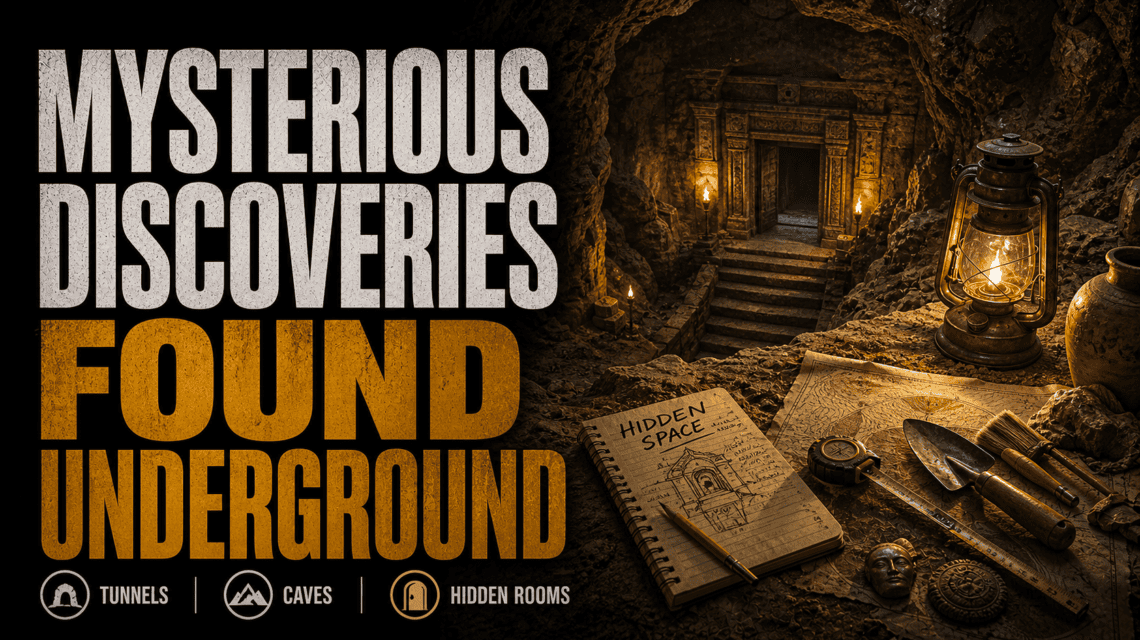
 There is a particular thrill to a doorway in the ground — a shaft, a sealed chamber, a staircase leading down into the dark. Some of the most astonishing archaeological finds have come not from ruins on the surface but from spaces people deliberately carved beneath it. These sites grip us because they combine two powerful ideas: enormous hidden effort, and the sense that the ground we walk on has been keeping secrets.
Derinkuyu: a city under Cappadocia
In 1963, so the widely reported account goes, a resident of the Turkish region of Cappadocia knocked down a wall in his home and found a passage leading into an entire subterranean city. Derinkuyu descends many levels underground — with room for thousands of people plus livestock — carved into soft volcanic rock and equipped with ventilation shafts, wells, stables, kitchens, and heavy rolling stone doors that could seal it from the inside. It was almost certainly used as a refuge during times of invasion, a whole community’s worth of life folded down into the earth.
The Hypogeum of Ħal Saflieni
On the island of Malta lies one of the world’s most extraordinary prehistoric structures: a three-level underground complex cut into limestone around 4000–2500 BCE, rediscovered by accident during construction in 1902. The Hypogeum served as both a sanctuary and a necropolis, with the remains of thousands of individuals found within. Its chambers were carved to echo the shapes of Malta’s above-ground temples, and one space is renowned for acoustic properties that make low voices resonate through the rock — a reminder that “hidden” did not mean crude.
The Paris Catacombs
Beneath Paris runs a vast network of former limestone quarries, and in the late 18th century officials repurposed part of it to solve a public-health crisis: overflowing city cemeteries. The bones of an estimated six million people were transferred underground and, remarkably, arranged — stacked and patterned into walls of skulls and femurs stretching through the tunnels. Only a small, regulated section is open to visitors today, but the scale of the ossuary makes it one of the most visited hidden spaces on earth.
Lascaux and Chauvet: art in the deep dark
Some underground spaces preserve not refuge but imagination. The Lascaux caves in southwestern France, found by teenagers in 1940, hold vivid Paleolithic paintings of horses, aurochs, and deer roughly 17,000 years old. The nearby Chauvet cave, discovered in 1994, contains even older art — on the order of 30,000 years — including lions and rhinos rendered with startling skill. Both are now sealed to the public to protect the fragile pigments, with replicas built for visitors. That people ventured deep into pitch-black caverns to make art speaks to why hidden spaces move us: they are evidence of intention reaching across almost unimaginable time.
Why hidden spaces hold us
The fascination is not only about treasure or the macabre. Underground spaces trigger a mix of curiosity and unease — the thrill of the concealed, the puzzle of who made this and why, and the humbling realization that history has layers literally beneath our feet. Each of these sites was invisible to the surface world until an accident or a search revealed it, which is exactly what makes the next unopened doorway so hard to resist imagining.
Related Reading
Research Notes
- Pew Research Center
- Edison Research True Crime Consumer Report
- Google Trends Summergeist
- AP / Publishers Weekly best-seller list
Editorial note: Mad Over Stories prioritizes source-aware storytelling. For true crime and real-life topics, we avoid naming private individuals unnecessarily, distinguish confirmed facts from interpretation, and update articles when better information becomes available.
More From Mad Over Stories
- Best Mystery Thriller Books
- Unsolved Mysteries Explained: The Complete Guide
- Mystery And Discovery Stories
You Might Also Like
Books Like Verity: 7 Twisty Psychological Thrillers to Read Next
People Found Alive Years After Going Missing

Strange Deep Sea Discoveries That Prove the Ocean Still Has Secrets

Best Locked-Room Mystery Books for Readers Who Love Impossible Crimes
Ancient Mysteries Still Unsolved: What We Know, What We Guess, and What Remains


1 Comment