 Mad Over Stories Team
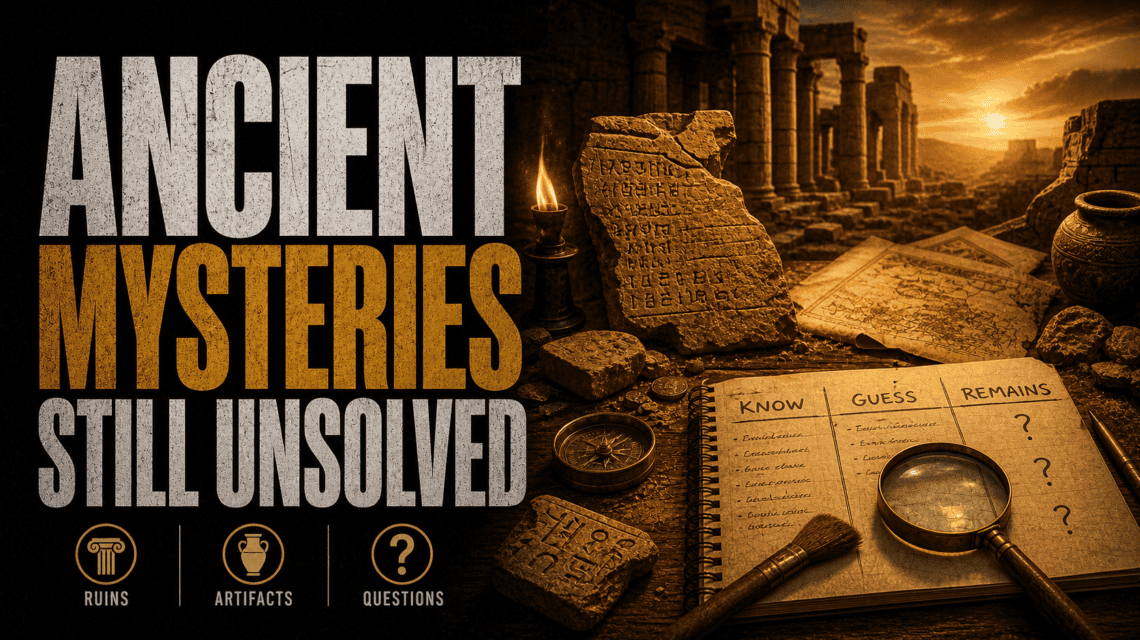
 The best ancient mysteries are not blank spaces where anything goes — they are places where solid scholarship and open questions sit side by side. Archaeologists usually know a great deal about what was built and when, and much less about why or exactly how. Keeping those two categories separate is what protects a genuine puzzle from turning into a fantasy.
Göbekli Tepe: monuments before farming
What we know: On a hilltop in southeastern Turkey, excavations led by the late Klaus Schmidt from 1995 revealed massive T-shaped stone pillars, some over five meters tall and carved with animals, arranged in circular enclosures. Radiocarbon dating places the site around 9600 BCE — thousands of years before Stonehenge and before the region shows clear evidence of agriculture or cities. What we guess: Its exact purpose. The popular claim that ritual gathering here “drove” the invention of farming is one hypothesis, not settled fact, and interpretations of the carvings remain debated. What is not in doubt is the site’s age, which forced scholars to rethink the old assumption that farming had to come before monumental building.
The Antikythera mechanism: a Greek analog computer
What we know: Recovered in 1901 from a Roman-era shipwreck off the Greek island of Antikythera, this corroded bronze device has been studied with X-ray and CT imaging that revealed dozens of precision gears. It is an astronomical calculator, dated to roughly the 2nd century BCE, that modeled the positions of the sun and moon, predicted eclipses, and even tracked the four-year cycle of the ancient games. What we guess: Who built it and whether others existed. No comparable gearing survives from antiquity for over a thousand years afterward, which is why it remains astonishing — but its function is now well understood, not mysterious.
Stonehenge: sourcing the stones, debating the method
What we know: Stonehenge was built in stages from roughly 3000 to 2000 BCE. Geochemical analysis has traced the smaller “bluestones” to the Preseli Hills in west Wales, some 150 miles away, and the giant sarsens largely to West Woods near Marlborough. What we guess: Precisely how Neolithic builders transported and raised stones weighing many tons, and what the finished monument meant. Its alignment with the solstices is real and measurable; the “why” — burial ground, calendar, healing site, or several at once — is still genuinely open.
The Nazca Lines: visible mainly from above
What we know: Across the Peruvian desert, the Nazca people created enormous geoglyphs — straight lines, geometric shapes, and animal figures — between roughly 500 BCE and 500 CE by removing dark surface stones to expose lighter ground. Their scale and preservation in the dry climate are well documented, and new figures are still being found with drones and AI-assisted survey. What we guess: Their purpose. Leading ideas involve ritual pathways, astronomical or calendrical marking, and water and fertility rites, but no single explanation is confirmed. The “made for aliens” claim is not supported by evidence; the techniques were well within Nazca capability.
Roman dodecahedra: function unknown, and that’s honest
What we know: Around 120 small, hollow, twelve-sided bronze objects — each face pierced with a hole of differing size and studded with knobs at the corners — have been found across the former Roman northwest provinces. They are genuine Roman artifacts, typically dated to the 2nd–4th centuries CE. What we guess: Essentially everything else. No ancient text describes them, so proposals range from measuring or surveying tools to knitting aids, gaming pieces, or ritual objects. This is the rare case where the honest scholarly answer is simply: we do not yet know what they were for.
Related Reading
Research Notes
- Pew Research Center
- Edison Research True Crime Consumer Report
- Google Trends Summergeist
- AP / Publishers Weekly best-seller list
Editorial note: Mad Over Stories prioritizes source-aware storytelling. For true crime and real-life topics, we avoid naming private individuals unnecessarily, distinguish confirmed facts from interpretation, and update articles when better information becomes available.
More From Mad Over Stories
You Might Also Like
Books Like Verity: 7 Twisty Psychological Thrillers to Read Next
People Found Alive Years After Going Missing
Strange Deep Sea Discoveries That Prove the Ocean Still Has Secrets
Mysterious Discoveries Found Underground: Why Hidden Spaces Fascinate Us

Best Locked-Room Mystery Books for Readers Who Love Impossible Crimes

1 Comment