 Mad Over Stories Team
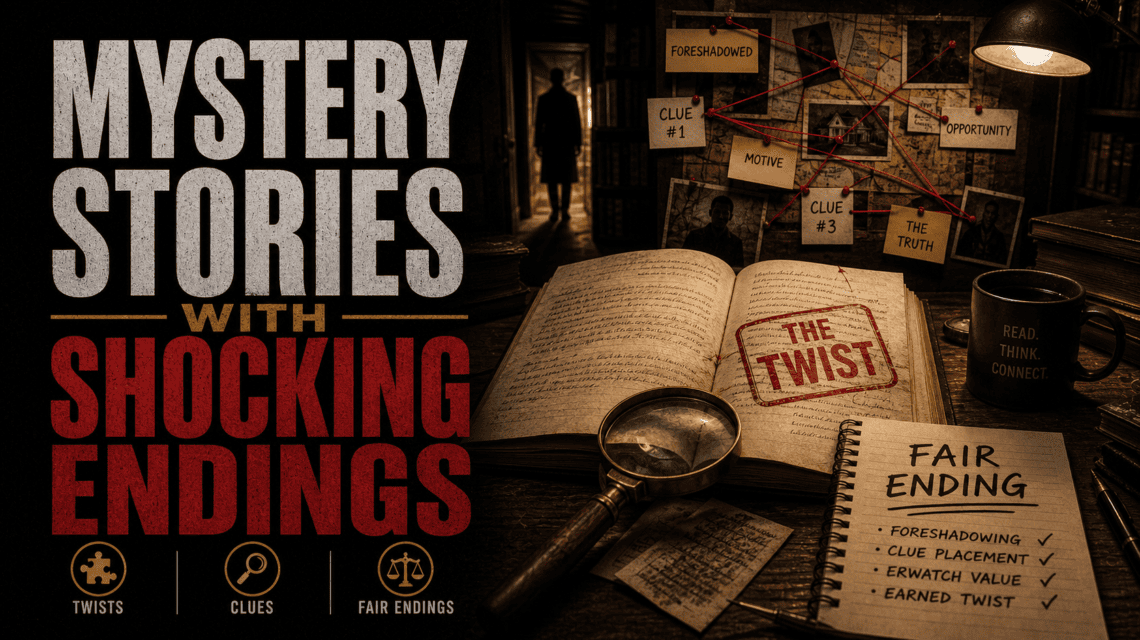
 A great twist does not simply surprise you — it makes you want to reread the whole book. The difference between a cheap shock and an earned one comes down to a single test: could an attentive reader, looking back, see that the ending was there all along? The best mystery writers spend the entire story hiding the answer in plain sight, then reveal that you had every clue you needed. (Mild spoilers for classic mysteries follow.)
Some links below are affiliate links. As an Amazon Associate, Mad Over Stories earns from qualifying purchases.
Fair play: the twist must be honest
In the golden age of detective fiction, writers half-jokingly codified the rules of a fair mystery — most famously in Ronald Knox’s “Decalogue” and S. S. Van Dine’s rules — all of which boil down to one idea: the reader must have a genuine chance to solve it. No last-minute secret twin, no clue withheld from the page, no solution that depends on information the author never shared. This is Chekhov’s gun applied to suspense: the revelation has to be built from parts the reader already handled. When a twist violates that contract, it feels like a cheat; when it honors it, the surprise converts instantly into admiration.
Misdirection: showing you the truth and hoping you look away
Skilled misdirection does not hide the key fact — it makes you underweight it. The writer plants the crucial detail early, then buries it under a more dramatic distraction so your attention slides past. Agatha Christie was a master of this: in The Murder of Roger Ackroyd, the solution depends on an unreliable narrator whose account is technically truthful but arranged to mislead, so that the reader’s trust becomes the very thing that conceals the answer. Good misdirection is generous, not deceptive — the clue was always on the page.
The reader’s own assumptions do the hiding
The most durable twists exploit assumptions the reader brings in unprompted. We assume a narrator is honest, that a sympathetic character is innocent, that a death is what it appears to be. Films like The Sixth Sense and novels like Gillian Flynn’s Gone Girl weaponize those defaults: nothing is technically lied about, but our expectations fill the gaps incorrectly. When the reveal arrives, the shock is not “the author tricked me” but “I tricked myself” — which is far more satisfying, because it implicates the reader in the mystery.
Why the reread is the real proof
The surest sign of an earned twist is that the second read is better than the first. In Agatha Christie’s And Then There Were None, ten strangers are lured to an island and killed one by one, and the solution is so tightly seeded that a rereading reveals the mechanism hiding in ordinary lines of dialogue. Alex Michaelides’s modern hit The Silent Patient works on the same principle — a reveal that recontextualizes an entire timeline you thought you understood. If the ending only works once, it was a gimmick. If it rewards you for going back, it was craft.
Try it yourself

And Then There Were None
The best-selling mystery novel of all time and a masterclass in the fairly-clued twist: ten strangers, an isolated island, and a solution seeded so precisely it demands a reread.
View on Amazon →For more titles built around endings that hold up under a second look, see our guide to the best mystery and thriller books.
Related Reading
Research Notes
- Pew Research Center
- Edison Research True Crime Consumer Report
- Google Trends Summergeist
- AP / Publishers Weekly best-seller list
Editorial note: Mad Over Stories prioritizes source-aware storytelling. For true crime and real-life topics, we avoid naming private individuals unnecessarily, distinguish confirmed facts from interpretation, and update articles when better information becomes available.
More From Mad Over Stories
You Might Also Like
Books Like Verity: 7 Twisty Psychological Thrillers to Read Next
People Found Alive Years After Going Missing

Strange Deep Sea Discoveries That Prove the Ocean Still Has Secrets

Mysterious Discoveries Found Underground: Why Hidden Spaces Fascinate Us
Best Locked-Room Mystery Books for Readers Who Love Impossible Crimes