 Mad Over Stories Team
The most honest way to start this article is to admit that, statistically, you are not unusual. In a 2022 YouGov survey, half of all American adults said they consumed true crime regularly. In a 2010 University of Illinois study, women picked true crime books over neutral non-fiction at roughly three times the rate of men. And in the most cited piece of contemporary research on the topic — Vicary and Fraley’s “Captured by True Crime” — researchers found that the people most drawn to the genre weren’t disturbed or desensitised. They were curious, alert and, more often than not, planning.
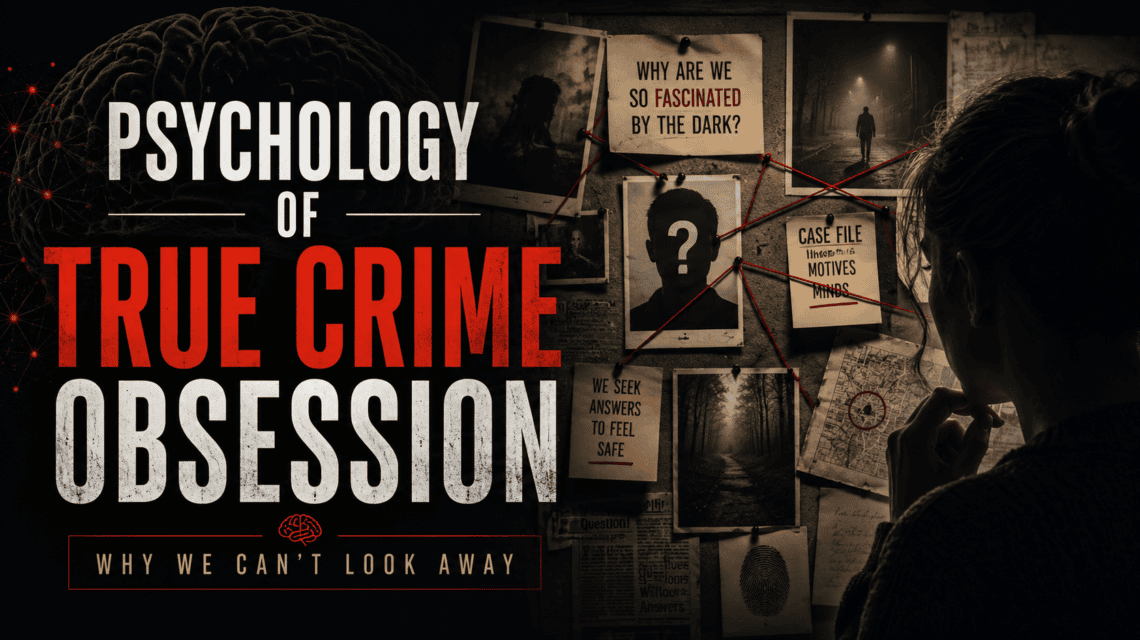
True crime obsession isn’t a quirk. It’s a well-studied behavioural pattern with at least four overlapping causes — and one cost worth taking seriously.
This is the science of why our brains can’t put the genre down. If you’d like the format context first, our ultimate true crime documentary guide covers what we’re actually watching, and the companion piece on the five most baffling unsolved cases of the last decade shows the kind of story most likely to trigger the response we’re about to describe.
1. Curiosity about extreme behaviour — at a safe distance
The dominant academic explanation for true crime’s pull is that it satisfies a deep, evolutionarily useful instinct: the urge to study dangerous behaviour without being exposed to danger. Psychologists call this morbid curiosity, and it’s one of the most consistently measured traits in the audience.
Coltan Scrivner’s 2021 work at the University of Chicago found that people with higher morbid curiosity scores were more resilient during the early Covid lockdowns — they were better at tolerating ambiguity and frightening information. Other studies have linked morbid curiosity to lower (not higher) anxiety levels in people who actively seek out frightening media. The brain treats true crime as a controlled rehearsal: a way to study extreme outcomes with the comforting knowledge that the channel can be paused or closed at any moment.
This is the same instinct that draws people to disaster journalism, plague history and survival narratives — and it’s why true crime fans rarely sit cleanly in any one demographic.
Read more: the complete guide to the world’s greatest unsolved mysteries.

If you want to understand the minds behind these crimes from the people who actually interviewed them, start here.

Mindhunter
The FBI profiler whose real serial-killer interviews shaped how we understand criminal psychology.
View on Amazon →2. Pattern recognition and the puzzle-solving reward
True crime is, structurally, a puzzle. There is evidence, there are competing theories, there is a missing answer. The brain’s reward circuitry — particularly the dorsal striatum — fires when we close cognitive gaps, and a well-edited episode of The Staircase or a 90-minute reinvestigation doc is basically a slow-drip delivery system for that exact reward.
Researchers studying serial-content viewing have noted that long-form true crime sits in the same neurological neighbourhood as prestige drama and mystery novels: it offers the satisfaction of pattern-completion stretched across many hours. Fans of the genre will often describe the experience in the language of detection — “I noticed something on the audio nobody else has caught” — and that’s not just metaphor. The brain is doing detective work, and the dopamine response is real.
This is why anthology series and case explainers underperform compared to single-case deep dives. A 50-minute summary delivers the puzzle’s outline; an eight-hour series delivers the dopamine drip.
If you want to see the same pattern-recognition instinct working on a non-criminal story, our long-read on the 23-year secret buried under an ordinary town park uses the same narrative architecture true crime fans respond to — buried clue, slow reveal, satisfying resolution.
Read more: the man who vanished in 1987 and the credit card receipt that resurfaced.
3. A sense of preparedness — especially for women
The most-cited finding in true crime research comes from Amanda Vicary and Chris Fraley’s 2010 study at the University of Illinois. They asked participants to choose between books on different topics, and women selected true crime over neutral non-fiction at roughly three times the rate of men. When asked why, the dominant reasons women gave were not entertainment-led. They were about learning: how victims were attacked, what warning signs they missed, what they wished they’d done.
Subsequent surveys — including Edison Research’s 2022 podcast audience report — have repeatedly found that women make up around 70% of the true crime audience and consistently rank “feeling more prepared” as a primary motivation. The genre functions, for a meaningful share of its audience, as a kind of safety syllabus.
This is worth taking seriously rather than mocking. Statistically, women are at higher risk of stalking, intimate-partner violence and certain categories of assault. The genre’s audience has rationally identified true crime as one of the few mainstream formats that talks about those risks in operational detail. Researchers studying this dynamic — including a 2023 University of Texas paper — argue that the “preparedness” motivation is best understood as functional, not pathological.
4. Empathy, justice and the moral verdict
True crime also scratches a moral itch that ordinary news does badly. A breaking news story rarely tells you who is guilty, why, and what should happen next. A true crime series, by design, builds towards a moral verdict — even when the legal verdict is messy. That gives audiences the rare experience of moving from confusion to clarity inside a single sitting.
Psychologists have linked this to what researchers call just-world thinking: the deep cognitive preference for stories where bad acts are explained and, ideally, punished. True crime is one of the few popular formats that consistently delivers on that preference. The good ones complicate it; the bad ones reduce it to satisfaction porn. Either way, the underlying machinery is the same.
This is also why audience-led campaigns — DNA-search fundraisers, podcast-driven reinvestigations, online tip lines — have become a structural feature of the genre. Once you’ve identified with the victim and assembled a moral verdict in your head, the next step is action.

The audience profile, in three numbers
If you’re wondering where you sit, here’s roughly the picture researchers paint of the modern true crime audience.
- ~70% are women, consistently across multiple US and UK audience surveys since 2018.
- The largest age cohort is 25–44, with the genre over-indexing on millennials and on the younger end of Gen X. Younger Gen Z audiences are growing fast, particularly on TikTok and YouTube.
- The average true crime fan consumes the genre at least weekly and is significantly more likely than the general population to also follow long-form investigative journalism and prestige drama.
None of this looks like the stereotype of the “obsessed” fan. It looks more like an alert, time-stretched adult using the format the same way other people use long-form journalism or premium drama.
The cost — and what the research says about managing it
True crime isn’t a free reward. The research on heavy consumption is small but consistent on three points.
First, sleep is the most commonly reported downside. A 2022 survey by the American Academy of Sleep Medicine found that one in three Americans had lost sleep to true crime content — particularly podcasts consumed in the hour before bed. The mechanism is straightforward: morbid curiosity is mildly arousing, and arousal interferes with sleep onset.
Second, heavy consumption is associated with what some researchers call availability heuristic distortion — a tendency to overestimate the prevalence of violent crime. People who consume a large amount of true crime content are statistically more likely to overestimate stranger-perpetrated violence and underestimate the much more common reality of intimate-partner harm. The genre doesn’t cause this distortion alone, but it contributes.
Third, the audience itself self-reports a clear “too much” point. In surveys, regular consumers describe a familiar pattern: a phase of intense binging followed by a deliberate pull-back, often after a particularly upsetting case. Researchers in this area have started calling this self-regulation, and it appears to be both healthy and common. The genre’s heaviest consumers are usually the most aware of when to stop.
The practical implication is small but useful: most of the costs of true crime obsession are manageable with small habit changes — moving consumption out of the hour before sleep, varying the content type, and being conscious of which cases are being chosen.
Read more: true stories with endings nobody predicted.

So why can’t we look away?
Because true crime is the rare popular format that satisfies four different psychological needs at once. It feeds morbid curiosity. It rewards pattern recognition. It gives a meaningful share of its audience — particularly women — a sense of practical preparedness. And it delivers a moral verdict that ordinary news rarely manages.
Any one of those would make for a sticky format. All four together make for the genre we have: enormous, growing, ethically complicated, and unmistakably here to stay.
If you’d like a curated set of cases that hit all four notes at once, our companion piece on the five most baffling unsolved true crime cases of the last decade is the natural next read, and the broader true crime documentary guide covers the formats and the ethics worth knowing. For a story that doesn’t involve a crime but works on the same intuition-and-pattern machinery, the woman who kept dreaming of a street she’d never visited is a good companion read.
Frequently asked questions
Why are people, especially women, drawn to true crime?
Multiple peer-reviewed studies — beginning with Vicary and Fraley’s 2010 Illinois study — find that women are drawn to true crime at significantly higher rates than men, and consistently cite a sense of practical preparedness as the primary reason. Researchers describe this as functional rather than pathological: the genre is one of the few mainstream formats that discusses the categories of risk women statistically face in operational detail.
Is being obsessed with true crime unhealthy?
For most consumers, no. The research finds true crime fans are no more anxious, desensitised or violence-prone than the general population. The two consistently documented costs are reduced sleep when content is consumed close to bedtime, and a mild overestimation of stranger-perpetrated violent crime among heavy consumers. Both are manageable with small habit changes.
What is morbid curiosity?
Morbid curiosity is the academic term for the urge to study dangerous, frightening or unsettling subject matter from a safe distance. Researchers including Coltan Scrivner have found it to be a stable trait, weakly correlated with resilience, and a strong predictor of true crime consumption.
How much true crime is too much?
There isn’t a clinical threshold. Researchers note that the heaviest consumers tend to be the most aware of when to pull back, and recommend three simple self-checks: are you losing sleep to it, are you starting to feel disproportionately unsafe in everyday situations, and are you finding it harder to engage with non-crime content? Two or more “yes” answers is the most common signal to take a break.
Does watching true crime make you better at spotting danger?
Mostly no, but a little yes. The genre tends to over-represent rare stranger-led violence and under-represent the much more common reality of intimate-partner and acquaintance harm. However, it does measurably increase audience familiarity with concepts like grooming patterns, coercive control and the importance of preserving evidence — areas where mainstream news coverage is patchy. The net effect depends heavily on what kinds of cases you consume.
📚 Keep reading: our guide to the best true crime books.


1 Comment